
Have you ever loaded up your Wagon Queen Family Truckster and headed out on the open road in search of that great all-American experience? It is the quintessential family road trip! Sometimes, families head out west to experience a cross country adventure in family bonding. Other times, they can head to a city for a larger family reunion. No matter where you go, there is always something on the side of the road that catches your attention – historical markers.
According to Kevin M. Levin of the Smithsonian magazine, “Historical markers are a ubiquitous presence along many of the nation’s highways and country roads. You can spot their distinctive lettering, background color, and shape without even realizing what they commemorate. Virginia’s historical marker program is one of the oldest, beginning in 1926 with the placement of a small number of signs along U.S. 1 between Richmond and Mount Vernon.”[1] Since Virginia has the oldest historical markers, won’t you join me on an imaginary road trip to see the historical markers in Bedford County and the town of New London, Virginia. (I promise it won’t take the four and a half hours it would if we were in a car!*)
When you go to the Virginia Department of Historical Resources, you can access the database of all historical markers. In the search, I typed in Bedford County and received 17 different markers. The first one I chose was… Bedford K 134!
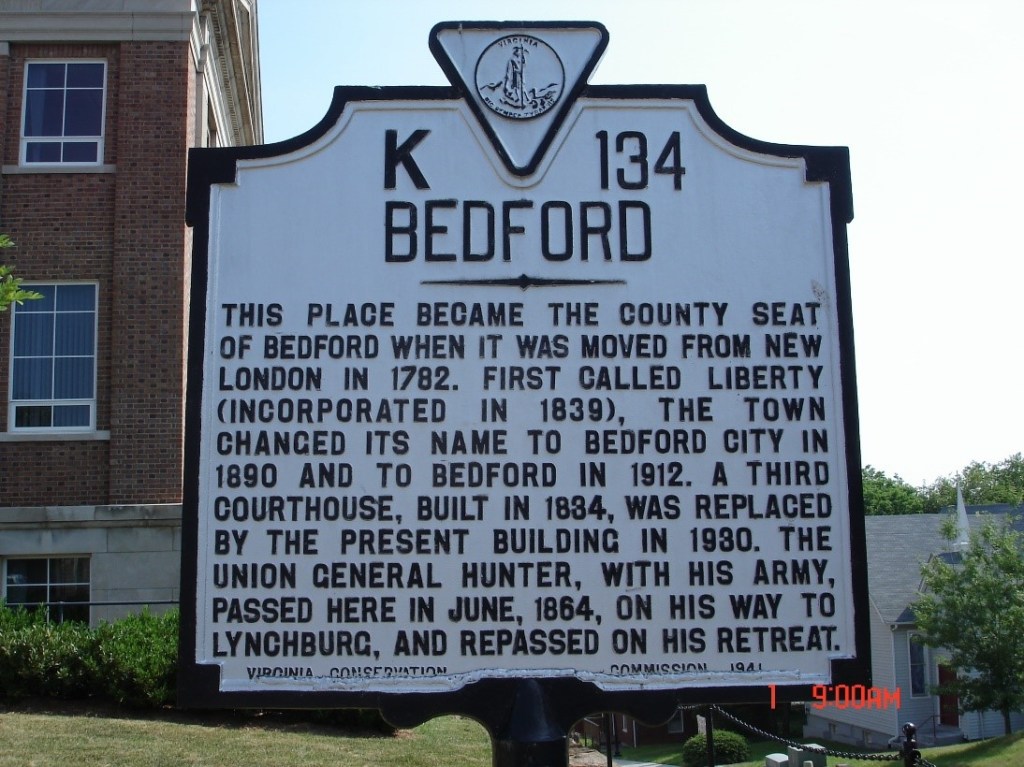
I dug a little deeper into Bedford than just what was written on the sign. Henry Howe’s Historical Collections of Virginia has an entire chapter on Bedford. When he wrote this “Liberty, the county-seat, is on the Lynchburgh and Salem turnpike, 26 miles sw. and contains five mercantile stores, one Baptist, one Presbyterian, one Episcopal, and one Methodist church and a large and handsome court-house, built in 1834.”[3]
The next sign is the one that Henry Howe stated in his book. It is the one for the Lynchburg and Salem Turnpike.

We continue on our way into the town of New London in search of more signs. Of course, we must stop and read the one for the town itself!
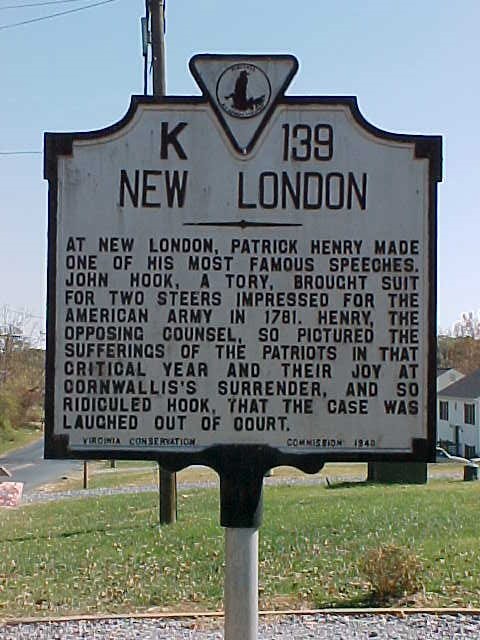
According to the DHR, New London was on “the old stage road, was the first county seat of Bedford; the first courthouse, built in 1755, was standing until 1856. In 1781, New London was raided by the British cavalryman, Tarleton, seeking military stores. It came into Campbell County in 1782. An arsenal here was afterward removed to Harper’s Ferry.”[6] According to Howe, “it contains 2 churches, a classical academy, and a few dwellings. It was founded several years prior to the American revolution.”[7]
Since Mr. Howe has discussed a “classical academy”, let’s head off to see the next road sign – New London Academy.

This school is still in operation today. The school’s website offers a history of their establishment. “Thomas Jefferson’s vision for the education of the masses of the people inspired concerned citizens of this area to request from the General Assembly of Virginia a charter “to incorporate trustees to an academy in the vicinity of New London.” On December 1, 1795, the Virginia General Assembly approved this bill and appointed prominent Bedford County men as trustees. Thus, New London Academy, named for the historic little village had its beginning.”[9] It seems that Thomas Jefferson had a huge impact on New London! So much so, that he actually had a home in Bedford County named Poplar Forest.
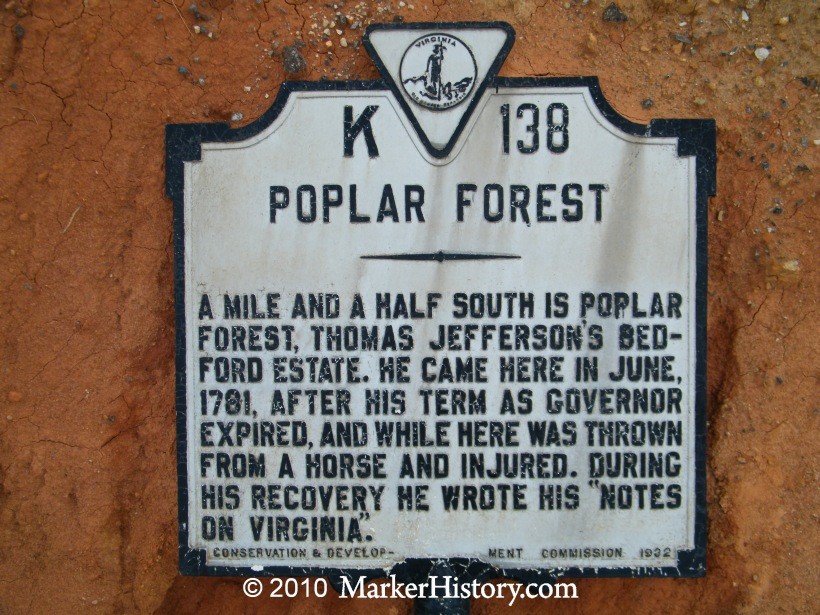
Thomas Jefferson was friends to many influential members of New London. Including James Steptoe. The Callaway-Steptoe Cemetery is final stop on our tour.

There is more to the town of New London than these few signs but historical signs like these are a way to capture the imagination and look deeper into our shared history. There is Mead’s Tavern and the Bedford Alum Springs Hotel which are both owned by Liberty University. “Liberty has plans of archaeological and architectural investigations for the hotel and property.”[12] There are already archaeological projects at Mead’s Tavern. You could explore the famous names who called this place home, like William Calloway, Patrick Henry, and Thomas Jefferson. And the history extends beyond the Revolutionary War! You can explore Hunter’s Raid which happened during the Civil War. There is really so much to see, do, and learn!
Historical markers do have a downfall. They cannot give the full story. For instance, the sign for New London K 139 states that there was a case involving Patrick Henry and John Hook over two steers but little else is said. The idea of these signs is to give just a nugget of history to help you want to find the rest of the story!
I hope you enjoyed our little “trip” and I hope that it inspires you to seek out those historical signs along the side of the road. Who knows?! You may jump into a great road trip through history!
[1] Levin, Kevin M. “When It Comes to Historical Markers, Every Word Matters.” Smithsonian.com. Smithsonian Institution, July 6, 2017. https://www.smithsonianmag.com/history/when-it-comes-historical-markers-every-word-matters-180963973/.
*This is from my home in Baltimore County MD.
[2] “Bedford K 134.” Department of Historic Resources. Accessed December 6, 2019. https://vcris.dhr.virginia.gov/HistoricMarkers/.
[3] Howe, Henry. “Historical Collections of Virginia; Howe, Henry, 1816-1893 : Free Download, Borrow, and Streaming.” Internet Archive. Charleston, S.C., W. R. Babcock, January 1, 1970. https://archive.org/details/historicalcollec03howe/page/188.
[4] “Lynchburg and Salem Turnpike K 131.” Department of Historic Resources. Accessed December 6, 2019. https://vcris.dhr.virginia.gov/HistoricMarkers/.
[5] “New London K 139.” Department of Historic Resources. Accessed December 6, 2019. https://vcris.dhr.virginia.gov/HistoricMarkers/.
[6] Ibid.
[7] Howe, Henry. “Historical Collections of Virginia; : Howe, Henry, 1816-1893 : Free Download, Borrow, and Streaming.” Internet Archive. Charleston, S.C., W. R. Babcock, January 1, 1970. https://archive.org/details/historicalcollec03howe/page/218.
[8] “New London Academy K 141.” Department of Historic Resources. Accessed December 6, 2019. https://vcris.dhr.virginia.gov/HistoricMarkers/.
[9] “History of NLA.” New London Academy. Accessed December 6, 2019. https://bedfordnla.sharpschool.net/about_us/history_of_nla.
[10] “Poplar Forest K-138.” Marker History, November 30, -1. http://www.markerhistory.com/poplar-forest-marker-k-138/.
[11] “Callaway-Steptoe Cemetery K 135.” Department of Historic Resources. Accessed December 6, 2019. https://vcris.dhr.virginia.gov/HistoricMarkers/.
[12] “Bedford Alum Springs Hotel.” New London Museum. Accessed December 6, 2019. https://newlondonmuseum.org/bedford-alum-springs-hotel/.

 Seeking History