They say that the kitchen is the heart of the home. It is a place to gather for meals and reminisce about the day. Today’s kitchens are a miracle of innovative conveniences. Machines that wash your dishes at a push of a button. Coffee that will brew without having to hand grind the beans in a coffee grinder. Refrigerators that keep your food cold and freezers that keep things, like ice cream, frozen. If you want toast, you can grab a piece of sliced bread, insert it into a toaster and in a few minutes, voila! Even the butter you spread on that toast is easy to obtain.
Kitchens in the turn of the century were far different than the modern marvels of today. The idea of having toast was far more labor intensive than today. It meant stoking the fire in the stove and getting it up to temperature. This might require you to gather wood and light the fire. It also meant gathering the ingredients to make the bread. This required not only measuring, sifting, and mixing, but letting it rise, kneading it, and then baking it. Once cooled, then it needed to be sliced and toasted, most likely over an open flame on the stove. For the butter, that was another chore. Milking a cow, putting the milk into a churn, and then churning the milk until you finally achieved butter. It could take hours just for a piece of buttered toast!
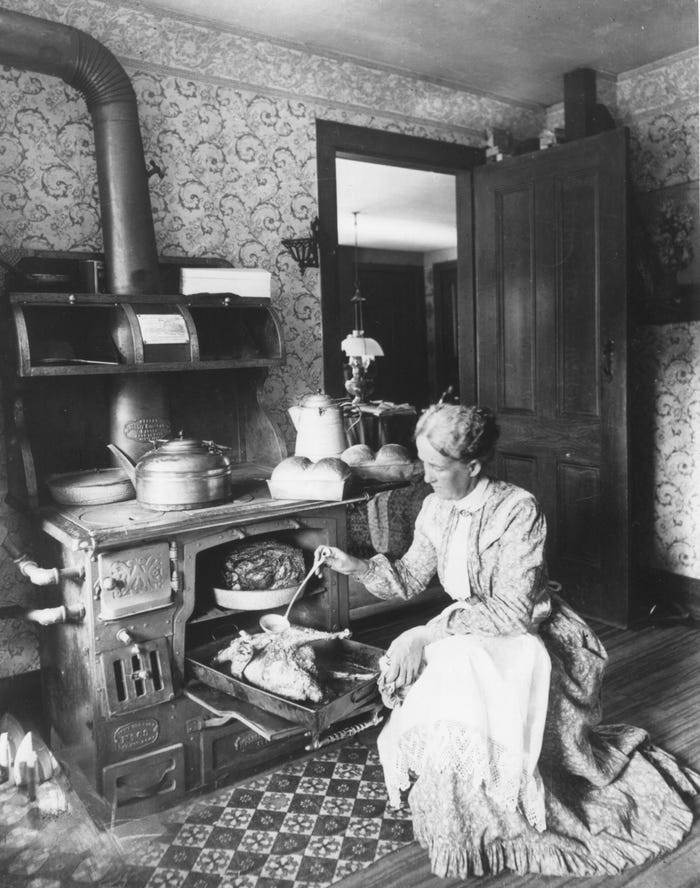
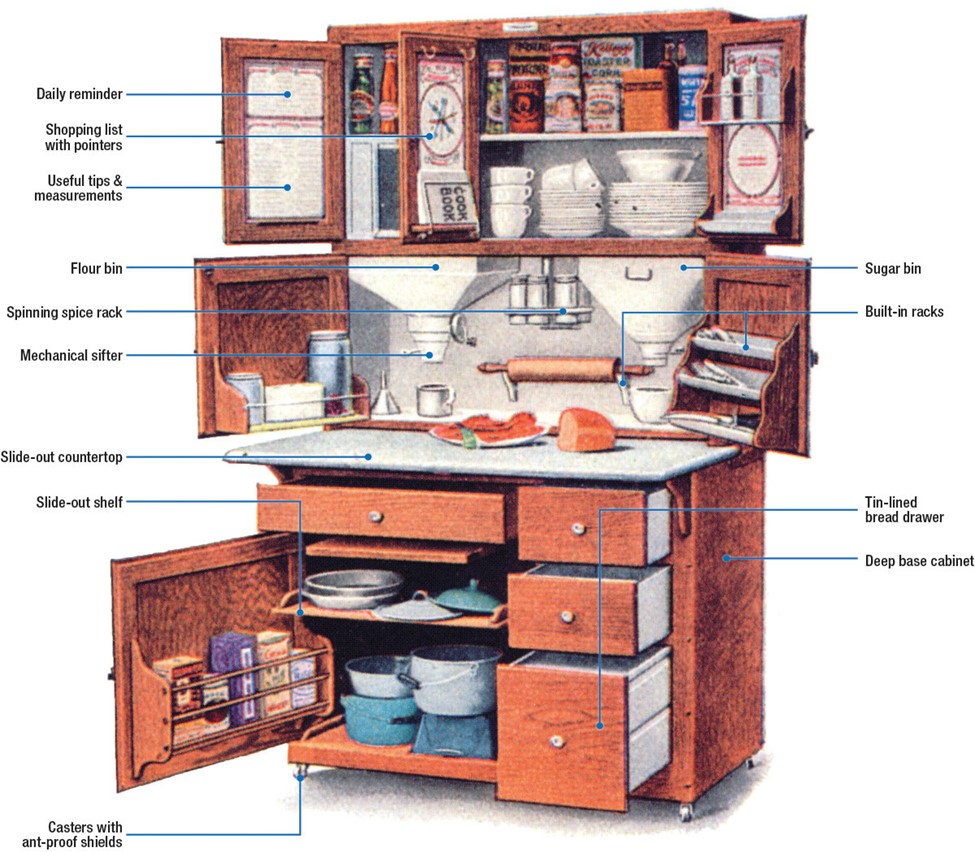
Typical 1900s kitchens were large open expanses with little storage space. Most of the food stuff was kept in pantries where any type of insect or vermin could easily gain access to it. What was a housewife to do? Enter a new marvel – the Hoosier Cabinet! An all in one food pantry, baking and food prep center, storage unit on wheels! This design included space for your plates, cooking utensils, as well as reminder lists for shopping and measuring conversions.[2]
While the design saved many steps in a housewife’s day, the original idea wasn’t initially intended to be this design. Four men started a venture to create a piece of agricultural equipment – a seed separator. James McQuinn, his son Emmett McQuinn and two partners, John M. Maring and Thomas Hart, purchased a furniture factory which had closed. Shortly after opening their business in Albany, Indiana one of the men began manufacturing stand-alone kitchen cabinets as well as the seed separators.[4]
A strange thing started to happen when they took their separators out to sell in their horse-drawn carts. Farmers didn’t want the separators, but their wives wanted the cabinets they sold. It didn’t take long for the men to realize that there needed to be a change in production. After a fire at their Albany site in 1900, they moved production to New Castle and the Hoosier Manufacturing Company was well on its way. While the Hoosier Cabinet wasn’t the first of its design, it was “the first product expressly designed to store food and kitchen equipment.”[5]
The success of this product created by the McQuinns, Hart, and Maring was largely based on their use of advertising, manufacturing, and distribution. It was the first to offer a payment plan so that every household could afford to own one. At the height of their popularity, almost 700 cabinets a day were produced” leading them to be “the largest manufacturer of kitchen cabinets in the U.S.”[6] While most of their advertising were in women’s publications, such as Ladies Home Journal, they also advertised in magazines and publications aimed at the head of the household, the husbands. The idea was to entice them into purchasing the cabinet for their wives so help them be happier women.[7]
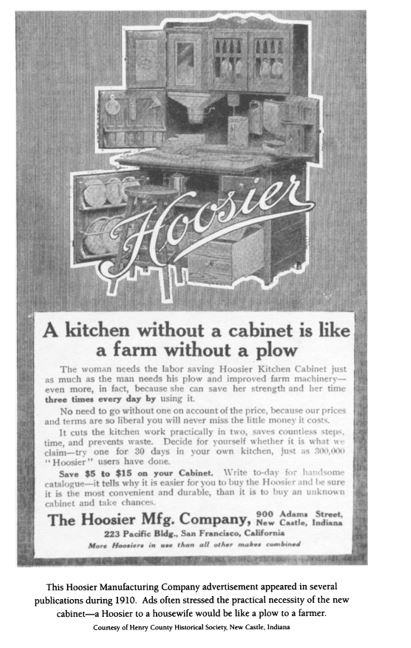
By 1916, the Hoosier Manufacturing Company had sold its one millionth Hoosier Cabinet. The price of the cabinet was roughly $50. Four years later they had sold over two million.[9] In the 1920s, they held an “annual kitchen design competition” where “designers and architects from around the country [send in] kitchen layouts that would incorporate a Hoosier Cabinet.”[10] The company continued to innovate so that the Hoosier Cabinet would continue to sell. Unfortunately, in the 1930s, wall mounted cabinets were starting out replace the Hoosier Cabinet as being more sanitary since it didn’t allow dirt to collect under it like the Hoosier did. By 1942, with World War II and the scarcity of materials, the company closed its doors.
The designers of the Hoosier Cabinet didn’t solve the world’s problems. Compared to other companies that started at the same time, like Hershey Chocolate, they couldn’t withstand that test of time. Today, many do not know the names of the designers of the Hoosier Cabinets outside of New Castle. The cabinets themselves are now considered collectables by many. Each one is a unique piece and they seek out different designs like those with a clock in the cabinet. While our modern kitchens are all about convenience, the Hoosier Cabinets were the first step in creating our kitchens of today. And it was all thanks to four men from Indiana.
Bibliography:
Hiller, Nancy R. The Hoosier Cabinet in Kitchen History. Bloomington, IN: Indiana University Press, 2009.
Hiller, Nancy. “Famous Furniture: The Hoosier Cabinet.” Woodworking Plans & Tools, May 26, 2017. https://www.woodcraft.com/blog_entries/famous-furniture-the-hoosier-cabinet.
HILLER, NANCY. “The Hoosier Cabinet and the American Housewife.” Indiana
Magazine of History 105, no. 1 (2009): 1-30. Accessed September 17, 2020. http://www.jstor.org/stable/27792949.
Indiana Cabinet: Indiana Cabinets including Hoosier, Sellers, McDougal, Napanee, etc. Gas City, In: L-W Book Sales, 1997.
Kennedy, Philip D. Hoosier Cabinets. Indianapolis, IN: P.D. Kennedy, 1989.
Luppold, William G., and Matthew S. Bumgardner. “The Wood Household Furniture and Kitchen Cabinet Industries: A Contrast in Fortune.” Forest Products Journal. Allen Press, November 1, 2009. https://meridian.allenpress.com/fpj/article/59/11-12/93/136718/The-Wood-Household-Furniture-and-Kitchen-Cabinet.
Olito, Frank. “Then and Now: Here’s How US Kitchens Have Evolved throughout the Years.” Insider. Insider, March 21, 2019. https://www.insider.com/then-and-now-how-us-kitchens-have-evolved-2019-3.
Radford, Darrel. “Hoosier Kitchen Cabinets – An Unforgettable Impact.” Document Center / Browse Documents / City of New Castle, IN, July 8, 2013. https://www.cityofnewcastle.net/eGov/apps/document/center.egov?view=item%3Bid.
[1] Olito, Frank. “Then and Now: Here’s How US Kitchens Have Evolved throughout the Years.” Insider. Insider, March 21, 2019. https://www.insider.com/then-and-now-how-us-kitchens-have-evolved-2019-3.
[2] Hiller, Nancy. “Famous Furniture: The Hoosier Cabinet.” Woodworking Plans & Tools, May 26, 2017. https://www.woodcraft.com/blog_entries/famous-furniture-the-hoosier-cabinet.
[3] Indiana Cabinet: Indiana Cabinets including Hoosier, Sellers, McDougal, Napanee, etc. Gas City, In: L-W Book Sales, 1997.
[4] Hiller, Nancy. “The Hoosier Cabinet and the American Housewife.” Indiana Magazine of History 105, no. 1 (2009): 1-30. http://www.jstor.org/stable/27792949.
[5] Luppold, William G., and Matthew S. Bumgardner. “The Wood Household Furniture and Kitchen Cabinet Industries: A Contrast in Fortune.” Forest Products Journal. Allen Press, November 1, 2009. https://meridian.allenpress.com/fpj/article/59/11-12/93/136718/The-Wood-Household-Furniture-and-Kitchen-Cabinet.
[6] Radford, Darrel. “Hoosier Kitchen Cabinets – An Unforgettable Impact.” Document Center / Browse Documents / City of New Castle, IN, July 8, 2013. https://www.cityofnewcastle.net/eGov/apps/document/center.egov?view=item%3Bid.
[7] Hiller, pg 13.
[8] Hiller, pg. 11.
[9] Kennedy, Philip D. Hoosier Cabinets. Indianapolis, IN: P.D. Kennedy, 1989.
[10] Hiller, pg. 22.

 Seeking History