Blog Feed

Chasing Carmen Sandiego

[1]

When I was growing up, video and computer games were in their infancy.    We didn’t have the amazing graphics in all their technicolored glory.  The first video game I played was Atari Pong.  The first computer game was Oregon Trail which I could never beat!  I always died of dysentery long before I ever made it to Oregon.

In my teens, games started to evolve and one of my favorites was the Carmen Sandiego series.  I loved chasing her across the United States and around the world, looking for clues to catch the bad guys!  In 1999, the greatest one of the series, in my humble opinion, came out – Carmen Sandiego’s Great Chase Through Time.  This game allowed me to chase her through history!

I bet you’re wondering why this game is so important to me.   The Carmen Sandiego series was more than just a game.  It allowed the player to learn while having fun.  Don’t believe me?  You can play three new Carmen Sandiego’s adventures on Google Earth.  You can find the Crown Jewels, the Keys to the Kremlin, or Tutankhamun’s Mask (links below).[2]  In the series, each player was able to learn about art, geography, science, and most importantly, history. 

 For most kids, history is boring.  It is a rare teacher that can make history exciting for his/her students.  It’s all names, dates, and places.  Blah blah blah.  So, introducing a game like Carmen Sandiego adds an element of fun!  It, like historical movies, can be the springboard a student needs to find a love of history.  It may not be historically accurate in all accounts, but if presented correctly, it can be the little spark that makes the flames ignite. 

 Think back to your days in high school.  Was your class exciting?  Do you remember having fun and learning something new and different?  Did it challenge you to think creatively and dig deeper for a fuller understanding as to the reasons why this event happened or what repercussions occurred?  Most people will answer no.  And this, my dear reader, is why people hate history.  Names. Dates. Places.  Cue the sound of the Peanuts teacher talking.

What if it could be different?  Professor Marcus Collins had a brilliant idea.  He gave an assignment to his freshman college students and asked them to “write ‘a historiographical analysis of the history you studied at school.”[3]  The article titled “Historiography from below: How undergraduates remember learning history in school”, examines how these students remembered their classes then and now.  Many of these young historians stated that their elementary school time was spent with traditional form of history.  The teachers taught the traditional/Rankean method “because it is simpler to teach the basics in order to understand more broad history later on.’”[4]  Some of the students stated that when they reached high school, the teachers started to expand their knowledge beyond the traditional views, seeking to show them a more global experience to history.  They were “exposed to “new” history in action, represented by ‘more complex topics, such as social standings and … economic influences.”[5] This allowed them the opportunity to gain a deeper understanding of history. But sadly, some of the students stated that they knew no other way of learning history except the traditional way, so it was a shock when they entered college and began to see new ways of exploring it.

To be honest, this is exactly how I learned history.  Names, dates, places.  When I was at university, I was taught to teach history the same way to my students.  Historiography wasn’t something that was discussed.  So, imagine my shock when I returned to get my master’s and had a WHOLE NEW WAY of learning about history!  It had been 15 years since I attended college and now everything was different! 

The study of history is something that must evolve and grow especially where our students are concerned.  Professor Caroline Hoefferle explains why we need to teach the study of history, and especially historiography, to our students.  She writes in her article, “Teaching Historiography to High School and Undergraduate Students”, “that most high schools and undergraduate courses heavily rely on textbook readings.  History textbooks are normally written in a narrative format, which sends the message to students that they are simply presenting “the truth” about the past, implying that there are no other interpretations of the events, no other truths about the past.”[6]  She goes on to say that teaching “historiography not only enlightens students as to the inside story of the historical profession, but it also makes history more alive and interesting to them.  This takes them away from being simply passive receivers of the truth, to active pursuers of the truth.”[7]  What an amazing concept!  Making history interesting!

  Professor Eric Morgan continued this idea when he used the virtual world of Second Life “to transport [his students] to Europe during the summer of 1916, to the very epicenter of the First World War.”[8]  Imagine being taught World War I like that!  A new way of experiencing history can make all the difference.

I had teachers who made their subjects fun so much so that when I taught, I wanted to do the same thing.  Funny thing is, I now have former students who are now teachers and are adding fun to their classes too because I showed them learning could be fun.  I guess chasing Carmen wasn’t such a bad idea after all!

Links:

Crown Jewels: https://earth.google.com/web/@1.50184563,-12.41938094,-26243.34460046a,63196239.48846817d,35y,359.99993244h,0t,0r/data=CjwSOhIgYmU3N2ZmYzU0MTc1MTFlOGFlOGZkMzdkYTU5MmE0MmEiFnNwbC14LXgteC1zcGxhc2hzY3JlZW4

Keys to the Kremlin: https://earth.google.com/web/@17.90693717,-12.41937117,-34607.65249819a,57359668.97d,35y,0.00004064h,18.19296234t,0r/data=CjwSOhIgZjJhMmExN2E0MDZlMTFlOTk5MGE5OWYyYWQ2OTYwMTgiFnNwbC14LXgteC1zcGxhc2hzY3JlZW4

Tutankhamun’s Mask: https://earth.google.com/web/@17.90693717,-12.41937117,-34606.55899502a,57359668.97d,35y,0.00004064h,18.19296234t,0r/data=CjwSOhIgN2ZhM2Q1Njg0MDZlMTFlOTg2Y2U5OWYyYWQ2OTYwMTgiFnNwbC14LXgteC1zcGxhc2hzY3JlZW4

Bibliography

“Carmen Sandiego’s Great Chase Through Time (The Learning Company) (1999): The Learning Company: Free Download, Borrow, and Streaming.” Internet Archive. The Learning Company, January 1, 1999. https://archive.org/details/CarmenSandiegosGreatChaseThroughTimeTheLearningCompany2001Disc2Of2.

Collins, Marcus. “Historiography from Below: How Undergraduates Remember Learning History at School.” Teaching History, no. 142 (2011): 34-38. http://www.jstor.org/stable/43260435.

“Follow Carmen Sandiego Across Google Earth!” Carmen Sandiego – Houghton Mifflin Harcourt. Accessed October 30, 2019. https://www.carmensandiego.com/game/.

Hoefferle, Caroline. “Teaching Historiography to High School and Undergraduate Students.” OAH Magazine of History 21, no. 2 (2007): 40-44. http://www.jstor.org/stable/25162115.

Morgan, Eric. J. “Virtual Worlds: Integrating “Second Life” into the History Classroom.” The History

Teacher 46, no. 4 (2013): 547-59. http://www.jstor.org/stable/43264156.


[1] “Carmen Sandiego’s Great Chase Through Time (The Learning Company) (1999): The Learning

Company” Internet Archive. The Learning Company, January 1, 1999.  

[2] “Follow Carmen Sandiego Across Google Earth!” Carmen Sandiego – Houghton Mifflin Harcourt.  Accessed October 30, 2019. https://www.carmensandiego.com/game/.

[3] Collins, Marcus. “Historiography from Below: How Undergraduates Remember Learning History at School.” Teaching History, no. 142 (2011): 34-38. http://www.jstor.org/stable/43260435.

[4] Ibid, pg. 36.

[5] Ibid, pg. 36.

[6] Hoefferle, Caroline. “Teaching Historiography to High School and Undergraduate Students.” OAH Magazine of History 21, no. 2 (2007): 40-44. http://www.jstor.org/stable/25162115.

[7] Ibid, pg. 41.

[8] Morgan, Eric. J. “Virtual Worlds: Integrating “Second Life” into the History Classroom.” The History Teacher 46, no. 4 (2013): 547-59. http://www.jstor.org/stable/43264156.
History in Images and Light


           The silver screen.  Hollywood.  The mere mention of it brings to mind images of starlets in evening gowns accompanied by dashing leading men while spotlights pierce the night sky.   Yet the collective work of these people, the actors, directors, writers, etc., can have a profound impact on how the public remembers events, especially historic events.

            This dissertation will focus on how Hollywood has changed the public memory of history.  For example, recall the movie Titanic with Kate Winslet and Leonardo DiCaprio.  It was an epic story of star-crossed lovers set against the backdrop of a doomed voyage.  But was it historically correct?  Looking beyond the drama portrayed on the screen, this work will compare the actual events to those produced by Hollywood.  It will illustrate that which was done as accurately as possible and that which was truly movie magic.

            To do this, several films will be chosen.  The choice of films will made due to several criteria.  First, the film must be created in the United States.  No foreign created films will be considered.  This will limit which films are viewed, as Hollywood is an American creation therefore the films that will be used must be created there. 

Second, the film must be about a war or police action that America participated in.  This can either be about the event or a person who had a major impact on the event.  The reason for this, is to give the broad topic of history on film a more focused analysis.  This will include films ranging from colonization, especially the French and Indian War, through to the Iraq War. 

Third, the film must be either in the Library of Congress National Film Registry or have been nominated or won an Oscar for Best Picture.  The Library of Congress National Film Registry was created in 1988 to “ensure the survival, conservation and increased public availability of America’s film heritage” (LOC, 2021).  Each year, 25 films, including documentary, short films, narrative films and animated films are inducted after a vigorous process.    To be nominated for an Oscar by the Academy of Motion Picture Arts and Sciences, means that you are one of the 10 best films of that year and are voted upon by only “active and life Academy members” (AMPAS, 2021).  By narrowing the film choices even further by employing these final criteria, the emphasis of Hollywood’s impact will be seen in a clearer light.

As previously stated, there will be several films that will be examined, and each of them will be documented that they fit within the criteria.  Once that is done, then the fun begins!  The film will be viewed in its entirety and copious notes taken so that any historical, biographic, or geographic gems will be recorded.  Then extensive research will be conducted to create a comparison for the film.  Some films have characters that are based on real people while other characters are completely fictional.  Let’s look at Titanic again.

Titanic was filmed in the United States, so it meets the first criteria.  It is also on the Library of Congress National Film Registry, inducted in 2017, and won the Best Picture Oscar in 1998.  It meets the final criteria.  But unfortunately, it doesn’t meet the second one – it isn’t about a war that America participated in.  But that doesn’t mean it isn’t worth investigating.  Let’s look at it from another perspective.

It is based on a historic event.  The RMS Titanic was a British passenger ship owned and operated by the White Star Line.  It did set sail April 10, 1912 and sank five days later.  These are undisputed facts.  Exactly what happened to Titanic is still a bit of a controversy.  There was an iceberg involved. Did the iceberg create one giant gash or were there a myriad of little ones that flooded multiple compartments? Also, questions have arisen about hull integrity due to a possible fire on the ship. There are many theories about how this ship that was considered unsinkable sank. 

Let’s see how the movie Titanic could be applied to the premise that Hollywood has changed the public memory of how the actual Titanic is remembered.  If this dissertation were about gender roles, economic issues during the turn of the century, or social standards between the different passengers, then Titanic would easily fit the bill.  It would be easy to compare those criteria to the way that Hollywood portrayed the sinking of the ship.   You could look beyond the romance of the penniless Jack to the poor heiress Rose to see why a match would have been created for Rose to Cal.  The dinner is a prime example of the idea of societal differences and class distinctions.  This was during the Gilded Age, so you could look at how Rose’s character evolved as many women did during that time branching out beyond the home.  But, most people remember the sad lost love and the happy reuniting in the end. 

Hollywood took liberties with Titanic, but it also had historical facts.  This dissertation will apply critical questions to the films that fit the criteria stated and examine how Hollywood has changed public memory of the events and people.  There are other film historians who have completed work on Hollywood’s impact and their work will be utilized.  Together, it will be combined to see if Hollywood’s final products have truly changed people’s memory of history.            

But for now, grab some popcorn and get comfortable.  It’s almost time for the movie to begin!

Bibliography:

“Complete National Film Registry Listing: Film Registry: National Film Preservation Board: Programs: Library of Congress.” The Library of Congress, 2021. https://www.loc.gov/programs/national-film-preservation-board/film-registry/complete-national-film-registry-listing/.

“Experience Over Nine Decades of the Oscars from 1927 to 2021.” Oscars.org | Academy of Motion Picture Arts and Sciences, 2021. https://www.oscars.org/oscars/ceremonies/2021.

“Titanic Movie Poster.” Walmart.com, 2021. https://www.walmart.com/ip/Titanic-1997-27×40-Movie-Poster/113097885.

A Tale of One Country in Two Different Times

“It was the best of times, it was the worst of times, it was the age of wisdom, it was the age of foolishness, it was the epoch of belief, it was the epoch of incredulity, it was the season of Light, it was the season of Darkness, it was the spring of hope, it was the winter of despair.”[1]

            Charles Dicken’s story, A Tale of Two Cities, is the perfect analogy for the United States between 1917 and 1941.  In that 24-year period, the United States entered two world wars, saw the economy expand and collapse, witnessed the destruction of farmland, and the creation of a stronger Federal government.  It truly was the best of times and the worst of times. 

            Through it all, American citizens dealt with an ever-changing world of conflicting ideals and policies. Should the country be “dry” with the 18th Amendment or should it be repealed?  Will Prohibition lead to greater crime and corruption or will it lead to great prosperity?[2]  Should they keep the gold standard or abandon it thereby allowing the government “unlimited power to print money.”[3]  Should we enter a European War or remain isolated?  Will it matter if we stay isolated?  What of the costs of a global war? Should the country have a small government presence, or should it take a more active role like FDR advocates?

            The country was out of more than just jobs during the Depression.  The cost of World War I was staggering.  The New York Times printed an official list of the Allies cost, both human and monetary, for World War I.  The United States suffered over 262,000 casualties, either dead, wounded or missing.  The monetary cost was estimated to be $200,000,000,000 according to the Federal Reserve Board in 1919.[4]  Imagine the devastation of losing a husband, father, brother, or other family member that was considered the breadwinner and provider for the family.  This is part of the reason why there was reluctance to move forward and engage in World War II.  People remembered the losses.  It had only been a few decades since the ending of the last one.  It took a Sunday morning bombing to wake the nation.

But what of the in between time?  Twenty-four years of a rollercoaster ride with the government and the changing of presidents.  Hoover’s more conservative policies of a “balanced budget and small government” yet Roosevelt’s actions were far different.  He acted as if he were “mobilizing the nation for war” and “went on an aggressive spending campaign, nearly doubling government consumption and investment in one year.”[5]  Imagine the utter shock that must have created within the country to go from a small and steady, yet losing, to a huge government deficit with the hopes of getting the country back on track from the throws of the Great Depression. 

            When Roosevelt was elected President, his first 100 days was electrifying.  During that time, “commodity prices skyrocketed,”[6]  and he changed the balance of the government taking on greater power so to push through his New Deal.[7]  This included projects like the TVA, the creation of the Hoover Dam which not only created jobs but provided housing, and even the Lend Lease Act which provided war materials for our allies while keeping the United States out of World War II.  That is, until December 7, 1941. 

            Historically, there is no one root cause of the Great Depression.  There were many factors.  There is also no one root cure that led to recovery from the Great Depression.  Economically, war and a strong government spending pattern helped tremendously but it wasn’t the only reason that it ended.  The problem with the Great Depression is that it wasn’t an insulated occurrence just within the borders of the United States.  Several countries suffered from a recession/depression.  One of the key countries was Germany.  The crushing reparation payments coupled with their bankrupt economy helped lead to the rise of one man who took his country from that devastation to being a global superpower.  Like Roosevelt, Hitler’s plan to end the economic depression in his country included work programs to create jobs, like building the Autobahn and producing the Volkswagen which was known as the “People’s Car.”[8] 

            There is one thing that many people agree upon regarding the Great Depression.  It was a time of great change.  During this time period, so many lives were changed, and some were lost.  The government morphed into the giant that is known today.  Even now, historians debate those changes in economics, politics, and policies that created the Great Depression.  It is that debate that will continue to change how this period is remembered.  As Bob Dylan wrote…

“Come writers and critics who prophesize with your pen
And keep your eyes wide, the chance won’t come again
And don’t speak too soon, for the wheel’s still in spin
And there’s no tellin’ who that it’s namin’
For the loser now will be later to win
For the times they are a-changin’.”[9]   


[1]Dickens, Charles. Great Expectations. Oxford: Oxford University Press, 1998.  

[2]The debate on prohibition: a summing up: a comprehensive presentation of the arguments of the wets and drys as they have developed in the testimony at the Washington hearings.” New York Times (1923-Current File), Mar 30, 1930. 1, http://ezproxy.liberty.edu/login?qurl=https%3A%2F%2Fwww.proquest.com%2Fdocview%2F99013708%3Faccountid%3D12085.

[3] Eggertsson, Gauti B. “Great Expectations and the End of the Depression.” The American Economic Review 98, no. 4 (09, 2008): 1476-516, http://ezproxy.liberty.edu/login?qurl=https%3A%2F%2Fwww.proquest.com%2Fdocview%2F233020472%3Faccountid%3D12085.

[4]Chronology of Events in Last Year of the War, 1918.” New York Times (1857-1922), Jan 02, 1919. http://ezproxy.liberty.edu/login?qurl=https%3A%2F%2Fwww.proquest.com%2Fdocview%2F100466774%3Faccountid%3D12085.

[5] Ibid, pg.1477

[6] Ibid, pg.1477

[7] Jeffries, J. W. “THE NEW NEW DEAL: FDR AND AMERICAN LIBERALISM, 1937-1945.” Political Science Quarterly 105, no. 3 (0, 1990): 397-418, http://ezproxy.liberty.edu/login?qurl=https%3A%2F%2Fwww.proquest.com%2Fdocview%2F61189914%3Faccountid%3D12085.

[8] Mroz, Albert. “Hitler’s Car: The Volkswagen Beetle’s Crazy Role In World War II.” The National Interest. The Center for the National Interest, November 2, 2019. https://nationalinterest.org/blog/buzz/hitlers-car-volkswagen-beetles-crazy-role-world-war-ii-93286.

[9] Dylan, Bob. “The Times They Are A-Changin’: The Official Bob Dylan Site.” The Times They Are A-Changin’ | The Official Bob Dylan Site, 2018. https://www.bobdylan.com/songs/times-they-are-changin/.

Four Men from Indiana

            They say that the kitchen is the heart of the home.  It is a place to gather for meals and reminisce about the day.  Today’s kitchens are a miracle of innovative conveniences.  Machines that wash your dishes at a push of a button.  Coffee that will brew without having to hand grind the beans in a coffee grinder.  Refrigerators that keep your food cold and freezers that keep things, like ice cream, frozen.  If you want toast, you can grab a piece of sliced bread, insert it into a toaster and in a few minutes, voila!  Even the butter you spread on that toast is easy to obtain. 

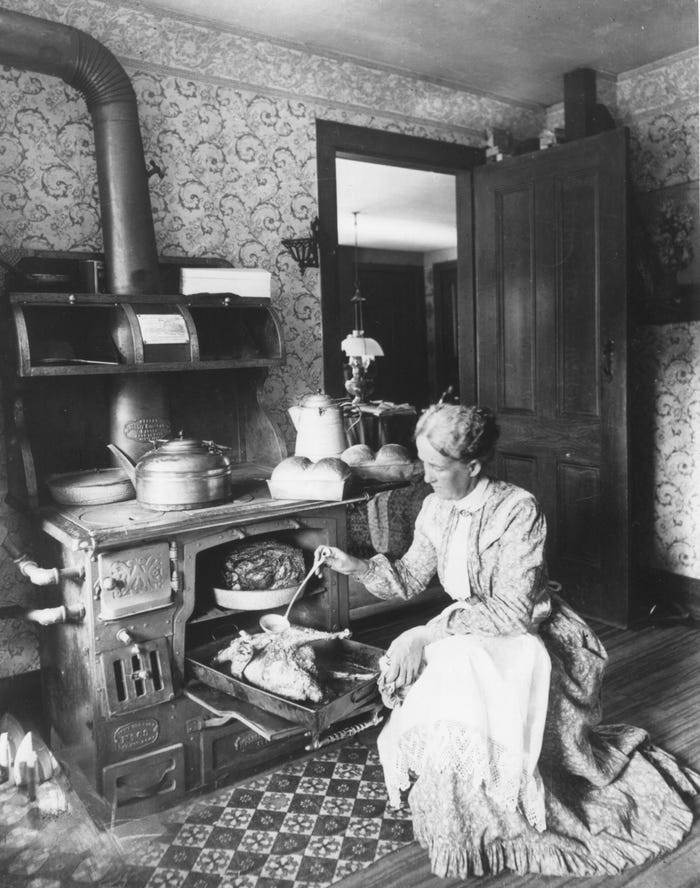
            Kitchens in the turn of the century were far different than the modern marvels of today.  The idea of having toast was far more labor intensive than today.  It meant stoking the fire in the stove and getting it up to temperature.  This might require you to gather wood and light the fire.  It also meant gathering the ingredients to make the bread.  This required not only measuring, sifting, and mixing, but letting it rise, kneading it, and then baking it.  Once cooled, then it needed to be sliced and toasted, most likely over an open flame on the stove. For the butter, that was another chore.  Milking a cow, putting the milk into a churn, and then churning the milk until you finally achieved butter.  It could take hours just for a piece of buttered toast!

[1]          

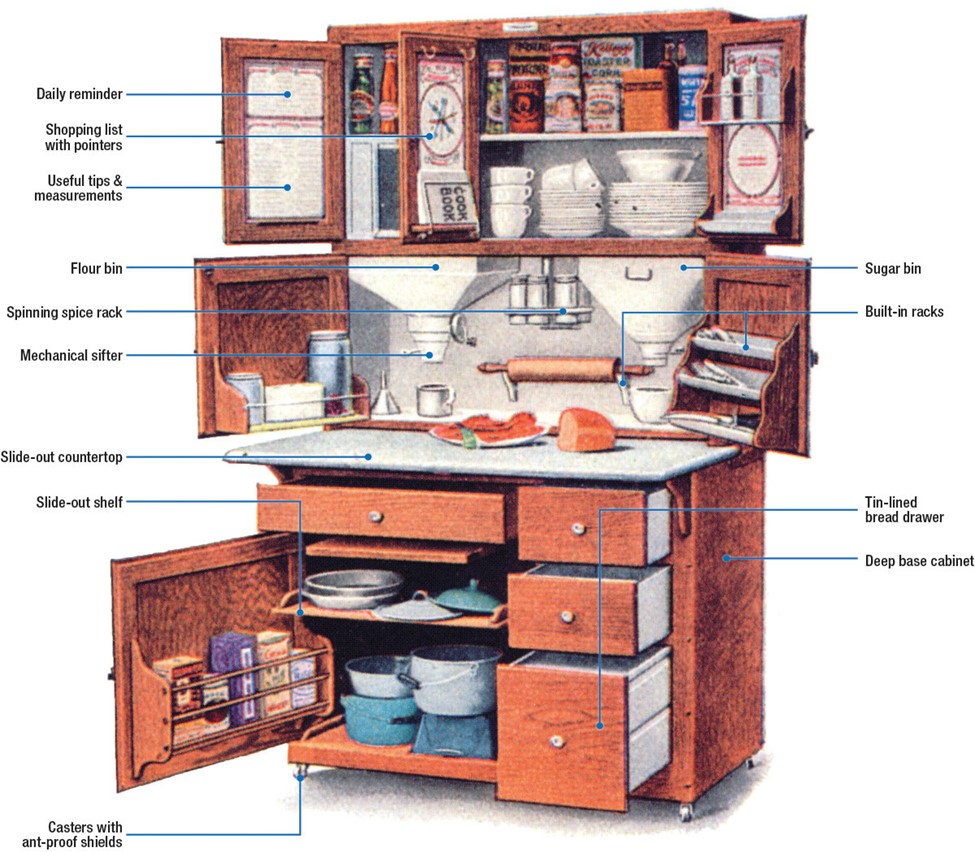
Typical 1900s kitchens were large open expanses with little storage space.  Most of the food stuff was kept in pantries where any type of insect or vermin could easily gain access to it.  What was a housewife to do?  Enter a new marvel – the Hoosier Cabinet!  An all in one food pantry, baking and food prep center, storage unit on wheels!  This design included space for your plates, cooking utensils, as well as reminder lists for shopping and measuring conversions.[2]

[3]

            While the design saved many steps in a housewife’s day, the original idea wasn’t initially intended to be this design.  Four men started a venture to create a piece of agricultural equipment – a seed separator.  James McQuinn, his son Emmett McQuinn and two partners, John M. Maring and Thomas Hart, purchased a furniture factory which had closed.  Shortly after opening their business in Albany, Indiana one of the men began manufacturing stand-alone kitchen cabinets as well as the seed separators.[4] 

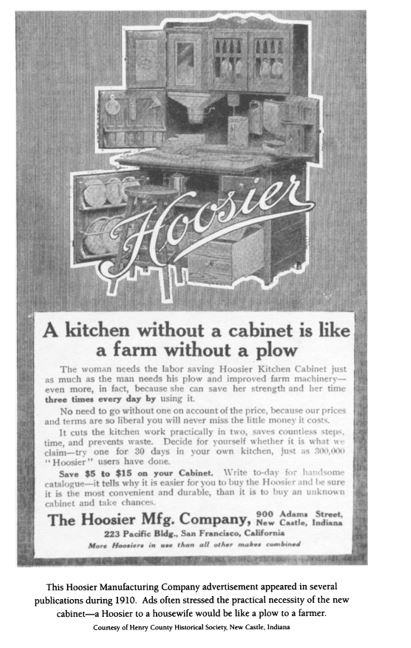
A strange thing started to happen when they took their separators out to sell in their horse-drawn carts.  Farmers didn’t want the separators, but their wives wanted the cabinets they sold.  It didn’t take long for the men to realize that there needed to be a change in production.  After a fire at their Albany site in 1900, they moved production to New Castle and the Hoosier Manufacturing Company was well on its way.  While the Hoosier Cabinet wasn’t the first of its design, it was “the first product expressly designed to store food and kitchen equipment.”[5]

The success of this product created by the McQuinns, Hart, and Maring was largely based on their use of advertising, manufacturing, and distribution. It was the first to offer a payment plan so that every household could afford to own one. At the height of their popularity, almost 700 cabinets a day were produced” leading them to be “the largest manufacturer of kitchen cabinets in the U.S.”[6]  While most of their advertising were in women’s publications, such as Ladies Home Journal, they also advertised in magazines and publications aimed at the head of the household, the husbands.  The idea was to entice them into purchasing the cabinet for their wives so help them be happier women.[7]

[8]          

By 1916, the Hoosier Manufacturing Company had sold its one millionth Hoosier Cabinet.  The price of the cabinet was roughly $50.  Four years later they had sold over two million.[9]  In the 1920s, they held an “annual kitchen design competition” where “designers and architects from around the country [send in] kitchen layouts that would incorporate a Hoosier Cabinet.”[10]  The company continued to innovate so that the Hoosier Cabinet would continue to sell.  Unfortunately, in the 1930s, wall mounted cabinets were starting out replace the Hoosier Cabinet as being more sanitary since it didn’t allow dirt to collect under it like the Hoosier did.  By 1942, with World War II and the scarcity of materials, the company closed its doors. 

            The designers of the Hoosier Cabinet didn’t solve the world’s problems.  Compared to other companies that started at the same time, like Hershey Chocolate, they couldn’t withstand that test of time.  Today, many do not know the names of the designers of the Hoosier Cabinets outside of New Castle.  The cabinets themselves are now considered collectables by many.  Each one is a unique piece and they seek out different designs like those with a clock in the cabinet.  While our modern kitchens are all about convenience, the Hoosier Cabinets were the first step in creating our kitchens of today.  And it was all thanks to four men from Indiana.

Bibliography:

Hiller, Nancy R. The Hoosier Cabinet in Kitchen History. Bloomington, IN: Indiana University Press, 2009.

Hiller, Nancy. “Famous Furniture: The Hoosier Cabinet.” Woodworking Plans & Tools, May 26, 2017. https://www.woodcraft.com/blog_entries/famous-furniture-the-hoosier-cabinet.

HILLER, NANCY. “The Hoosier Cabinet and the American Housewife.” Indiana

Magazine of History 105, no. 1 (2009): 1-30. Accessed September 17, 2020. http://www.jstor.org/stable/27792949.

Indiana Cabinet: Indiana Cabinets including Hoosier, Sellers, McDougal, Napanee, etc. Gas City, In: L-W Book Sales, 1997.

Kennedy, Philip D. Hoosier Cabinets. Indianapolis, IN: P.D. Kennedy, 1989.

Luppold, William G., and Matthew S. Bumgardner. “The Wood Household Furniture and Kitchen Cabinet Industries: A Contrast in Fortune.” Forest Products Journal. Allen Press, November 1, 2009. https://meridian.allenpress.com/fpj/article/59/11-12/93/136718/The-Wood-Household-Furniture-and-Kitchen-Cabinet.

Olito, Frank. “Then and Now: Here’s How US Kitchens Have Evolved throughout the Years.” Insider. Insider, March 21, 2019. https://www.insider.com/then-and-now-how-us-kitchens-have-evolved-2019-3.

Radford, Darrel. “Hoosier Kitchen Cabinets – An Unforgettable Impact.” Document Center / Browse Documents / City of New Castle, IN, July 8, 2013. https://www.cityofnewcastle.net/eGov/apps/document/center.egov?view=item%3Bid.


[1] Olito, Frank. “Then and Now: Here’s How US Kitchens Have Evolved throughout the Years.” Insider. Insider, March 21, 2019. https://www.insider.com/then-and-now-how-us-kitchens-have-evolved-2019-3.

[2] Hiller, Nancy. “Famous Furniture: The Hoosier Cabinet.” Woodworking Plans & Tools, May 26, 2017. https://www.woodcraft.com/blog_entries/famous-furniture-the-hoosier-cabinet.

[3] Indiana Cabinet: Indiana Cabinets including Hoosier, Sellers, McDougal, Napanee, etc. Gas City, In: L-W Book Sales, 1997.

[4] Hiller, Nancy. “The Hoosier Cabinet and the American Housewife.” Indiana Magazine of History 105, no. 1 (2009): 1-30. http://www.jstor.org/stable/27792949.

[5] Luppold, William G., and Matthew S. Bumgardner. “The Wood Household Furniture and Kitchen Cabinet Industries: A Contrast in Fortune.” Forest Products Journal. Allen Press, November 1, 2009. https://meridian.allenpress.com/fpj/article/59/11-12/93/136718/The-Wood-Household-Furniture-and-Kitchen-Cabinet.

[6] Radford, Darrel. “Hoosier Kitchen Cabinets – An Unforgettable Impact.” Document Center / Browse Documents / City of New Castle, IN, July 8, 2013. https://www.cityofnewcastle.net/eGov/apps/document/center.egov?view=item%3Bid.

[7] Hiller, pg 13.

[8] Hiller, pg. 11.

[9] Kennedy, Philip D. Hoosier Cabinets. Indianapolis, IN: P.D. Kennedy, 1989.

[10] Hiller, pg. 22.

Rise of the Robber Barons

 “Greed, for a lack of a better word, is good.  Greed is right, greed works.  Greed clarifies, cuts through, and captures the essence of the evolutionary spirit.  Greed, in all of its forms; greed for life, for money, for love, knowledge has marked the upward surge of mankind.”[1]  The famous quote from the movie Wall Street encapsulates the idea of business in the 1980’s.  American business is plagued with incidents of greed.   Open the paper, turn on the evening news, or watch the news feed of any social media outlet and one will see companies rocked by scandals of greed.  The concept of American greed isn’t a modern notion, but one that can trace its roots back to the very founding of the country.  Ruthless businessmen taking from the poor and working class who struggle to survive.  And nowhere was this more evident than during the Gilded Age with the rise of the Robber Barons.

 Who were these men, these kings of industry?  How did they gather wealth, power, prestige, and infamy?  Were they truly heartless capitalists seeking only to increase their own profits while condemning their workers to near slave-like laboring in factories? Or has history judged these men harshly in the light of other economic events, such as the Great Depression?  Even among historians, there is a vast difference of opinion regarding these men.  Some, like Andrew Carnegie, are seen as great philanthropists while others, like Jay Gould, are seen as the most evil and diabolical of men. 

When historians reference the powerful industrialists of the Gilded Age, they often refer to them as robber barons.  But what exactly is a robber baron?  According to Merriam-Webster, a robber baron refers to “an American capitalist of the latter part of the 19th century who became wealthy through exploitation (as of natural resources, governmental influence, or low wage scales).”[2]  He is essentially “a business owner or executive who acquires wealth through ethically questionable tactics.”[3]   It seems strange that Americans who believe in the ideas of economic freedom and self-governance would view with such a harsh light the actions of men like Carnegie, Vanderbilt, Rockefeller, and Gould.  Each of these men come from humble backgrounds and rose up to the top of their respective industries.  Each had their own struggles and scandals, yet each moved forward and created empires of wealth.

To truly understand why many view the actions of the Robber Barons with such animosity, we must look at the economics of the time.  Beyond the Great Depression and Great Recession, there were other times within American history where the economic future seems bleak.  In the roughly fifty years from the end of the Civil War to the beginning of World War I, there were “only seventeen-and-a- half partly or wholly prosperous years…indicating quiet clearly that for at least 65 per cent of the time some parts of the American economy were suffering financial distress”[4]  according to historian John Tipple.  If 65% of the economy was in distress, then it would be easy to understand why there would be an “attack against big businessmen.”[5] They are making the money while others are suffering.

 Yet there is one industry that forever link two of these men together – the railroad. Cornelius Vanderbilt created a vast shipping and railroad empire controlling the New York and Harlem, Hudson River, and New York Central railroads to name a few.  While he didn’t deal with the lines in the West, he did make one key move that made him a very rich and very powerful man.  He was able to consolidate railroads together to create his vast empire.  He was able to create “one of the largest railroad companies the world had ever seen” and would lead to what historian Alfred D. Chandler Jr. dubbed as “a managerial revolution.”[6]  Jay Gould, along with Daniel Drew and Jim Fisk, would eventually gain control the Erie Railroad by lowering the value of the stock shares, most which were held by Vanderbilt.  This became known as the Erie War and was one of two major events which tarnished Gould’s image. Eventually, Gould would rise back up from setbacks, head west and take over the Union Pacific railroad among others.[7]

 Unlike Vanderbilt, Carnegie, and Rockefeller, Gould’s reputation is far darker.  Compared the historical interpretations of Andrew Carnegie, most of which are favorable but those of Jay Gould are of an evil mastermind.  He was the Lex Luther to Carnegie’s Superman.  Reed Karaim portrayed Gould as “a secretive, austere man” who had risen “from humble origins…to become a ruthless financial predator whose backroom deal making earned him the moniker Mephistopheles of Wall Street.”[8]  While Vanderbilt was able to create an air of respectability, and Carnegie and Rockefeller were able to grant great philanthropic donations to gain public favor, Gould could do no right.  Jesse Seligman, a long-time friend of Gould’s, said he “found it “ironic” that Gould was always cast as the arch demon in any telling of the nation’s recent financial history.  If Gould was a sinner, exactly who were the saints?”[9]

 Historians have just begun to look at the actions of the Robber Barons in new ways.  Were they all sinners?  Were they all saints?  Were they just human men trying to gain power and wealth?  Their economic impact on America is still felt today.  There are libraries that carry the name Carnegie.  Research facilities sponsored by Rockefeller.  But perhaps it is time to research these men beyond the greed and title of Robber Baron to see all their actions in a new light.  It is something that will require further study.

Bibliography:

Karaim, Reed. “Gold Grab.” American History 47, no. 3 (August 2012): 56-61. History Reference Center, EBSCOhost.

Renehan, Edward. Dark Genius of Wall Street: The Misunderstood Life of Jay Gould, King of the Robber Barons. New York, NY: Basic Books, 2005

“Robber Baron.” Merriam-Webster.com. https://www.merriam-webster.com/dictionary/robber baron.

Stiles, T. J. The First Tycoon: the Epic Life of Cornelius Vanderbilt. New York, NY: Vintage Books, 2010.

Terrell, Ellen. “Robber Barons: Gould and Fisk.” Robber Barons: Gould and Fisk | Inside Adams: Science, Technology & Business. Library of Congress, September 26, 2012. https://blogs.loc.gov/inside_adams/2012/09/robber-barons-gould-and-fisk/.

Tipple, John. “The Anatomy of Prejudice: Origins of the Robber Baron Legend.” The Business History Review 33, no. 4 (1959): 510-23. Accessed September 4, 2020. http://www.jstor.org/stable/3111612.

Wall Street. Directed by Oliver Stone. 20th Century Fox Film Corp, 1987. DVD.


[1] Wall Street. Directed by Oliver Stone. 20th Century Fox Film Corp, 1987. DVD.

[2] “Robber Baron.” Merriam-Webster.com. https://www.merriam-webster.com/dictionary/robber baron.

[3] Ibid.

[4] Tipple, John. “The Anatomy of Prejudice: Origins of the Robber Baron Legend.” The Business History Review 33, no. 4 (1959): 510-23. Accessed September 4, 2020. http://www.jstor.org/stable/3111612.

[5] Ibid.

[6] Stiles, T. J. The First Tycoon: the Epic Life of Cornelius Vanderbilt. New York, NY: Vintage Books, 2010.

[7] Terrell, Ellen. “Robber Barons: Gould and Fisk.” Robber Barons: Gould and Fisk | Inside Adams: Science, Technology & Business. Library of Congress, September 26, 2012. https://blogs.loc.gov/inside_adams/2012/09/robber-barons-gould-and-fisk/.

[8]Karaim, Reed. “Gold Grab.” American History 47, no. 3 (August 2012): 56-61. History Reference Center, EBSCOhost (

[9] Renehan, Edward. Dark Genius of Wall Street: The Misunderstood Life of Jay Gould, King of the Robber Barons. New York, NY: Basic Books, 2005

Learning Amid A Pandemic

Hello everyone!  Here we are at the start of another term in my PhD saga. 

I spent time re-reading my posts from my spring class.  These were completed at the start of the pandemic.  In Maryland, we had just gone under a stay at home order but being an essential worker, I had to keep going to work at my office.  People still needed their products and my company supplies the necessary chemicals needed to make those products.  For me, my world continued but at a slightly a slower pace.  I believe it is safe to say things have changed.

Since then, my state has reopened… somewhat.  Students are still going to have to learn virtually for the first semester.  I have friends who teach, and they are worried that their students are not going to be able to complete their work properly.  They are worried about their students falling behind.  It is a legitimate fear.

Thankfully, my classes are held online so I am used to it.  This can be both a blessing and a curse.  You must be unbelievably disciplined to complete classes virtually.  This means that after a full day at work sending chemicals like caustic soda, sulfuric acid, or bentolite to their respective locations, I come home knowing that after I make supper and clean up, there is still more work to be done.  Sometimes, that work can be hours long.  I know I’ve been up too late when the night train comes by and he toots the horn when he sees my office light on.  That is around 1am. 

I understand how children today feel when they are told that they will be working virtually.  They will not be with their classmates but see them on a screen.  They can talk to their teachers but not be near them.  They complete assignments but now email or upload them instead of turning them in by hand.  It is difficult to do.  Harder to concentrate.  Harder to understand.  Harder all the way around especially if you now have the added distraction of home – tv, refrigerator full of snacks, comfy pjs and slippers.  Not an easy task at all. 

I have yet to meet a classmate in person.  It was the same for my master’s.  I have spoken with professors via email, Zoom, and telephone, but never face to face.  I understand the disconnection you have when you can see but never be with someone else.  Working on a project with classmates via Zoom or Webex adds another level of complexity beyond the requirements of the assignment.  With this class, there is a new wrinkle.  I get to interview an entrepreneur of my choice to create a video recording of the interview.  How do you interview when you cannot meet with them? How can you create a connection when you cannot even shake their hand?

Along with the interview complete with a transcript, there are also video blogs, written blogs, and the prerequisite research paper.  All to be done in the next eight weeks.  Add to that the required readings, research, annotated bibliography, and responses.  It is a lot, but I wouldn’t expect less from a PhD level course.  Doesn’t mean that I’m not tired just thinking about it!

Maybe that is how our students feel about virtual learning.  For them, it is a lot without many initial benefits.  They don’t get to see their friends in between classes.  They don’t get to spend time doing fun things together.  The distance between has grown as wide as the Pacific even in a little state like Maryland.  I wonder how they will adapt.  Will they thrive or falter?  Those, like me, who constantly chase that “A” grade will find ways to adapt and move forward.  It is the ones who struggle or who need the hands on that will find things more difficult.  The audio and visual learners should be ok but the kinesthetic may not be as lucky. 

Hopefully, things will improve.  The virus will end, and things will return to some sense of normal.  Well… as normal as things can be.  Fingers crossed for the new term for all who are in school – virtual or live and local. 

Stay safe.  Take care.  Be kind. 

K~

History and Memory: Current Event or History?

That morning dawned bright and clear.  It was going to be a beautiful fall day.  Then everything changed.  The day before, everything was full of optimism.  The day after, fear became the new normal and we were at war. 

We are just a little over a year away from the 20th anniversary of that fateful day and it got me thinking.  I remember that day with vivid clarity right down to the clothes I was wearing.  For me, that day will be forever etched in my memory. Yet for many of our incoming freshman and the ones that follow, it isn’t something that they remember.  For many of them, they weren’t even born. 

I began looking through the Smithsonian’s collection for 9/11 and to be honest, it was one of the hardest things I’ve had to do.  Their collection, September 11: Bearing Witness to History (https://amhistory.si.edu/september11/) includes artifacts from all three locations – New York, Washington D.C., and Pennsylvania.  They also include photos and covers of newspapers and magazines like Time.  In their statement about the collection, they state how difficult it was to collect these items especially since they “worried about appearing ghoulish in the face of bereavement.”[1] 

In their education section, they have a blog that really struck home for me.  “Teaching September 11: History or current event?[2]  How do you teach something that was a current event for most teachers/professors but history for our students?  How can you convey what it felt like on that day and how everything changed forever in those few moments? You have the memory, but they do not. 

I thought about how I could use the Smithsonian’s exhibit on 9/11.  What would my students think when they saw the artifacts?  Would they see the tragedy or just stuff?  The structural joint from the World Trade Center (https://amhistory.si.edu/september11/collection/record.asp?ID=105) looks like a rusted piece of twisted metal.  It has a description of it is and why it is important, but to them it is just a piece of metal.  The door from Brooklyn Squad 1 (https://amhistory.si.edu/september11/collection/record.asp?ID=49) could have been in an accident instead of being crushed when the towers fell.  The clock from the Pentagon’s helipad fire station (https://amhistory.si.edu/september11/collection/supporting.asp?ID=105&z=0) is just a normal clock until you realize that it was knocked off the wall when American Airlines flight 77 hit the Pentagon.  The clock shows the exact time the plane struck.   The photo of the investigators at the crash site in Shanksville (https://amhistory.si.edu/september11/collection/supporting.asp?ID=157&z=0) could have been a campfire gone out of control instead of the crash site of heroes stood up to stop terrorists. 

As I sit here and look over the artifacts and think about that tragic day, I keep hearing a song play in my head – “Where Were You (When the World Stopped Turning)” by Alan Jackson.  Jackson spoke about writing the song to Today’s Christian magazine.  Like me, he remembers that day clearly.  “He had just come in from his usual morning walk and turned on the television set in his kitchen. “The first plane had already hit,” recalls the country singer. “I was standing there when the second one hit.”[3]  He goes on to state that the song was written by “divine intervention.”[4]  

For me, I know that it would be difficult to teach this specific event in American history, but it is a necessary thing to do.  This is the perfect example of how history isn’t names, dates, and places.  Using this exhibit demonstrates that this was about people, their lives, and how things can change in an instant. 

For me, I was the second line of the second verse in Jackson’s song – “teaching a class full of innocent children.”[5] I was teaching middle school and was in English 7 when the first plane struck.  I was heading to make copies when I was pushed into the fourth-grade room to see the second plane strike.  I had to tell my homeroom class why we were leaving school early.  My boys wanted to go “kick some ass” (I didn’t correct their language).  My girls cried.  We prayed together and sat together at lunch.  I tried to comfort a teacher who couldn’t get a hold of her uncle or cousin who were working in the north tower.  I prayed in church with the other teacher after the students went home and was terrified because our stalwart middle school coordinator was softly crying next to me.  I knew it had to be bad when Madeline cried.  When I left school, I met my family at our firehouse.  We were there in case something happened, and we were needed.  The next morning, I went back to school to teach and life moved on.

I am sure that the Smithsonian will have a new exhibit for the 20th anniversary.  Remembrances will be held at all three sites with great solemnity.  Stories will be told, like the ones in the 9/11 Digital Archives (https://911digitalarchive.org/).  People will be asked “Where were you?”  For me, I want to help my students learn about the people of that day and their lives.  We lost over three thousand people and specifically 343 Fire, EMS, Police and Port Authority workers.  It is my job to help convey who they were and why their sacrifice is important to remember.  To tell the rest of their stories and my own. 

Bibliography:

“About the Collection.” Smithsonian National Museum of American History. Accessed April 29, 2020. https://amhistory.si.edu/september11/collection/about.asp.

The Essential Alan Jackson. Nashville, 2012.

https://amhistory.si.edu/september11

NMAH. “Teaching September 11: History or Current Event?” National Museum of American History, August 1, 2011. https://americanhistory.si.edu/blog/2011/08/teaching-september-11-history-or-current-event.html.

Owen, Linda. “Story Behind the Song.” Story Behind the Song: Alan Jackson’s “Where Were You (When the World Stopped Turning – Today’s Christian. Today’s Christian Magazine, 2003.


[1] “About the Collection.” Smithsonian National Museum of American History. Accessed April 29, 2020. https://amhistory.si.edu/september11/collection/about.asp.

[2] NMAH. “Teaching September 11: History or Current Event?” National Museum of American History, August 1, 2011. https://americanhistory.si.edu/blog/2011/08/teaching-september-11-history-or-current-event.html.

[3] Owen, Linda. “Story Behind the Song.” Story Behind the Song: Alan Jackson’s “Where Were You (When the World Stopped Turning – Today’s Christian. Today’s Christian Magazine, 2003.

[4] Ibid.

[5] The Essential Alan Jackson. Nashville, 2012.

Wonder, Excitement, and Joy

Why must everything be so serious? Dull and dry as a stale piece of toast. Please do not misunderstand me.  There are times and topics that must be handled with the greatest discretion and in an earnest nature.  I do not mean to present myself as the jokester or the fool.  But something is missing in higher education and it is so important.  Where is the wonder?  The excitement in learning? 

Think back to when you were younger, when learning was fresh and new.  It didn’t matter what the topic was, science or art, math or music, even gym. You were excited to see what the day would bring.  You were going to create something, learn something new!  We’ve lost that in higher education.  We’ve lost the wonder and the fun of learning.

Perhaps that is why I enjoyed teaching middle school so much.  I loved to see their faces as they grasped a concept or created something in an ancient way.  Instead of droning on about cuneiform, I had them create their own air-dry clay letters to “send” to another student in the class.  Instead of telling them about the burial rights of ancient Egypt, they learned how to mummify fruit and created their own tombs complete a protective curse, traps, and all the things that they wanted to take into the afterlife.  I taught using food analogies, like pizza to explain the birth and death cycle of a star or gummy lifesavers to create a model of chlorofluorocarbons.  My favorite lesson was helping them to discover that the laws of physics truly did help them perform better during a kickball game.  A practical application of a complex topic. 

Today, our students face so many challenges and our world has changed in way never imagined before.  We have students who come from different ethnic, religious, and cultural backgrounds to which, we as educators, must be cognizant of to minimize any faux pas.  But does that mean we must be like Ben Stein in “Ferris Bueller’s Day Off”?  Students completely oblivious to the lesson but the teacher keeps on going like the bunny with the drum.  Do we stand in front of a lectern and speak in a monotonous tone and bore everyone into hating our chosen field? How do we engage our online students when they could be in completely different time zone and you never “see” them face to face? How can you bring that joy back into learning?

For me, learning history isn’t just a memorization of dispassionate names, dates and places and then reciting it back.  History isn’t like multiplication tables you learned in elementary school.  These are people’s lives and their decisions that led them to that point we are investigating.   I want them to learn that history isn’t linear nor is it static.  Everything is intertwined, interdependent and constantly evolving all over the globe.   I want my students to experience my passion for history and to (hopefully) become inspired by it.  There is an old axiom – do what you love, and you’ll never work a day in your life.  I get to express my love of history every day to my students and experience the joy of telling them the rest of the story.  (Hooray for Paul Harvey!)

I believe in challenging my students so that those who are advanced learners continue to excel and exceed those challenges.  But I am ever vigilant for those students who struggle or who require extra assistance.  I tell them to meet with me in private and we will go over it together to find ways for them to be successful.  As one of my favorite books says on its cover – DON’T PANIC!  We’ve all be there at one time or another when we encounter something that is more than we expected and are struggling to understand it.  My weakness is math, especially Algebra.  I couldn’t understand why you were putting letters with my numbers if I wasn’t writing a check! (And telling my students that usually gets them to smile and relax.)  We are all human with our own strengths and weaknesses.  My job is to not only convey the knowledge and love of history but to assist my students in finding ways to use their strengths and encouraging them to look beyond any supposed weaknesses. 

While pursuing my PhD in Higher Education Administration at NDMU, we spent a great deal of time exploring education topics from diversity to creating new policies to making curriculum changes.  I revisited a TED talk by Carol Dweck.  She discusses how many students rush from one A to the next in a constant need for validation.  During my master’s degree, I realized that I was doing the exact same thing.  I kept pushing myself for the next A.  It nearly crushed me when I received a B+ in a class!  Unfortunately, this is something I still do it today and so do many of our students. 

It is time for a change in how we present history.  If we can embrace diversity within our classrooms, then why can’t we embrace new ways of engaging our students so that they can expand how they learn and adapt to the challenges of higher education?  By giving them the chance to explore creative ways to handle challenges and projects, we are instilling in them skills that they can carry over into their adult lives and can assist them in their future endeavors.  Let us embrace new and creative ways of presenting our information so to activate their imaginations and minds.   If we can do this, then we can bring the wonder, the excitement, and the joy back in learning.  Imagine how those lessons can be applied into the world beyond our classroom!

Something Bold

“Boldly going where no man… where no one has gone before.”[1]

            At the end of our second week under restrictions because of the COVID-19 virus, my husband and I spent a quiet morning watching something other than the news.  We are both considered essential personnel, so we travel each day to our respective jobs, helping to keep our economy going.  Each night, we return, emotionally and physically exhausted, so the weekends have become even more precious. This particular Saturday morning, we enjoyed a cup of coffee and a Star Trek movie on cable.  It was the second of the original movies where Khan strikes out at Kirk and Captain Spock dies.  It was at the end of the movie, when Spock gives the famous monologue for this series.  In this version, it is still “no man”.  It wasn’t until the “Undiscovered Country” that it became “no one”. 

            It got me thinking.  After great trials, great advances seem to happen.  Case in point, the Renaissance after the late Middle Ages.  So, if this is our great trial with this virus, what great discoveries await us?  Would we start our journey into space or make great advances in science and technology?  Or would we start a great journey into being better humans?

            I pondered on this while thinking about this blog.  Many institutes of higher learning do not have the necessary steps in place to host online learning.  Many have shunned the idea of students learning solely online as they feel that being in class is a better option.  And I completely agree to a point.  It is difficult to complete lab work at home just as it would be difficult to complete the necessary clinical work.  But our chosen subject, history, is another story.

            In one of our readings, Anthony Picciano discusses how “distance education” were mainly used by adults who were “geographically distant from traditional brick and mortar schools and colleges.  The schools, colleges, and universities most interested on online learning…were those that had established distance education programs.”[2]    This is why certain higher education institutions are having such difficulty with the now necessary switch to totally online learning.  They weren’t set up for it in the first place!

            Our task this semester is to design a class to be taught online and in a traditional classroom.  This is our chance to help create that great journey for our potential students.  Out of this dark time, we now have the chance to bring the light into our student’s world.  This light is more than just history and more than just information.  It is a chance for us to use our God given talents to inspire and to enlighten.  God calls each of us to give of ourselves by helping our fellow humans.  As the Apostle Paul wrote in his second letter to the Corinthians “Therefore, since we have such a hope, we are very bold.”[3]  Now is our time to help our students “to boldly go” and learn as never before.


[1] Star Trek VI– the Undiscovered Country. Paramount Pictures, 1991.

[2] Picciano, Anthony G. Online Education: Foundations, Planning, and Pedagogy. New York: Routledge, 2019.

[3] 2 Corinthians 3:12.

Something Vital

I am so sorry for the delay in writing. I have finished another class and started my third at Liberty. This has been a very daunting task.

In our assignment for this week, we were challenged to write about presenting a Biblical Worldview in higher education and in our classrooms as well. Below, is my post to my class. It doesn’t matter which faith you subscribe to as long as it meets the last three words of this blog.

            I’ve spent a great deal of time thinking about this blog post and the implications of presenting a Biblical Worldview in today’s society.  I kept thinking of the great possibilities that this idea possessed but also the repercussions that it has while teaching.  I was fortunate to teach at a Catholic middle school, but even then, I found roadblocks in presenting a Biblical Worldview in my classroom since I was considered unworthy to teach religion or a religious point of view because I was an NRC.  After 8 1/2 years, and more parents telling the principal that their children learned more about religion in my history class than in Religion class, was I able to help but only to a point. 

            I struggled for a way to present the idea of teaching history from a Biblical point of view especially if you are teaching in a secular school.  I know that most of the prestigious schools in the country were founded as Christian universities, yet they have shied away from their original roots to seek secular acceptance.  David Dockery tried to explain this in his article “Toward a Theology of Higher Education.”  He writes that one of the main issues that many colleges and universities are confused where to put theological/religious studies.[1]  If you don’t know where to put something, how can it be an integral part of your school and your student’s education?  Simply put, it won’t be!

            Many of the colleges and universities today are stuck trying to find ways for their students to continue their studies in the throws of the Covid-19 pandemic.  They are struggling to get online classes setup for their students when many of them have never entertained the idea on teaching online.  Now would be the perfect time for them to integrate such a worldview into their new programs.  In the article, “Integrating a Biblical Worldview and Developing Online Courses for the Adult Learner”, Mary Quinn writes that “educators designing and developing curriculum for online adult students need to integrate faith in a way that reveals their own thorough understanding of the Christian worldview: they must embrace the task of identifying the faith assumptions of their own disciplines, so they can then challenge their students to do likewise.”[2]

            If we are to present a Biblical Worldview within history, then we must be able to share our faith with our students to help them make similar connections.  One of the best ways to share this was written in Paul’s letter to the Romans (15:4) “For everything that was written in the past was written to teach us, so that through the endurance taught in the Scriptures and the encouragement they provide we might have hope.”[3]   A Biblical Worldview isn’t learning solely about history but being able to provide something vital – HOPE.


[1] David S. Dockery, Toward a Theology of Higher Education. (JETS 62.1, 2019).

[2] Quinn, Mary E., Laura S. Foote, and Michele L. Williams. “Integrating a Biblical Worldview and Developing Online Courses for the Adult Learner.” Christian Scholar’s Review 41, no. 2 (2012): 163-73.

[3] Romans 15:4

END OF TERM – PHEW!

Hello everyone! Well, I’ve finished my first term for my history PhD! If you haven’t guessed by the picture, I did pretty well. I earned a 96.83%! Good old fashioned solid A! (They don’t have A+ on this scale. An A is the highest you can receive.)

It was an interesting term and I start back up again on January 13th. The first eight weeks will be on Development of Western Freedoms and then the second eight weeks of my Spring term will be on Teaching History. Yes, every eight weeks I change classes. This means that not only do I have my full-time job (40 hours a week), my volunteer work with my local, county and state firemen’s associations, and my home & family, I have to make sure that I keep up with the readings, writings, quizzes, etc. I am tired already!

Just in case you didn’t see the rest of my videos on YouTube, below is a list of links that will take you to those fun videos. I have also included a link to the game trailer I created for a class while I was working on my PhD for Higher Education. We had to create a game trailer for a game that we could use in the classroom. So, I created one about history! I hope you enjoy them!

I want to wish you a blessed holiday season! If you celebrate Christmas – Merry Christmas! Hanukkah – Hanukkah Sameach! Yule – Blessed Yule! Whatever you believe or celebrate – Merry Merry Happy Happy and wishing you all the best in the New Year!

Kathy

Video Links:

M*A*S*H, McCarthyism, and the Cold War – https://www.youtube.com/watch?v=rBtv4l9j5zo&t=23s

America’s Little Sweetheart – https://www.youtube.com/watch?v=epM1MP7bprM&t=1s

Epidemic – https://www.youtube.com/watch?v=PzWC0-ET1oI&t=7s

Hollywood’s Greatest Year – https://www.youtube.com/watch?v=AAhRUUix-E8

Christian Scholarship – https://www.youtube.com/watch?v=HSrIp4qMYpc&t=21s

Video Game Trailer – https://drive.google.com/file/d/1aGG5kIuTXy5Hq3g5xLi_R1cBY2-Kbrcq/view?usp=sharing