Blog Feed

Road tripping through history!


Have you ever loaded up your Wagon Queen Family Truckster and headed out on the open road in search of that great all-American experience?  It is the quintessential family road trip!  Sometimes, families head out west to experience a cross country adventure in family bonding.  Other times, they can head to a city for a larger family reunion.  No matter where you go, there is always something on the side of the road that catches your attention – historical markers. 

According to Kevin M. Levin of the Smithsonian magazine, “Historical markers are a ubiquitous presence along many of the nation’s highways and country roads. You can spot their distinctive lettering, background color, and shape without even realizing what they commemorate.  Virginia’s historical marker program is one of the oldest, beginning in 1926 with the placement of a small number of signs along U.S. 1 between Richmond and Mount Vernon.”[1]    Since Virginia has the oldest historical markers, won’t you join me on an imaginary road trip to see the historical markers in Bedford County and the town of New London, Virginia.  (I promise it won’t take the four and a half hours it would if we were in a car!*)

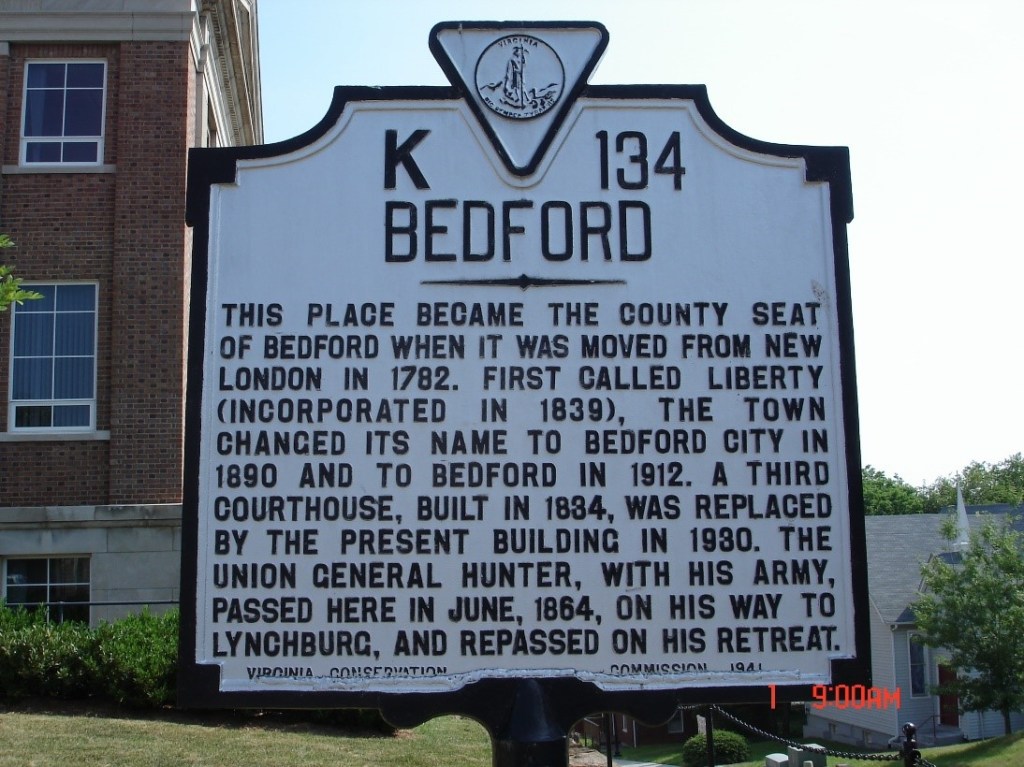
When you go to the Virginia Department of Historical Resources, you can access the database of all historical markers.  In the search, I typed in Bedford County and received 17 different markers.  The first one I chose was… Bedford K 134!
Click to View Full Image

[2]

I dug a little deeper into Bedford than just what was written on the sign.  Henry Howe’s Historical Collections of Virginia has an entire chapter on Bedford.  When he wrote this “Liberty, the county-seat, is on the Lynchburgh and Salem turnpike, 26 miles sw. and contains five mercantile stores, one Baptist, one Presbyterian, one Episcopal, and one Methodist church and a large and handsome court-house, built in 1834.”[3]

The next sign is the one that Henry Howe stated in his book.  It is the one for the Lynchburg and Salem Turnpike.

[4]

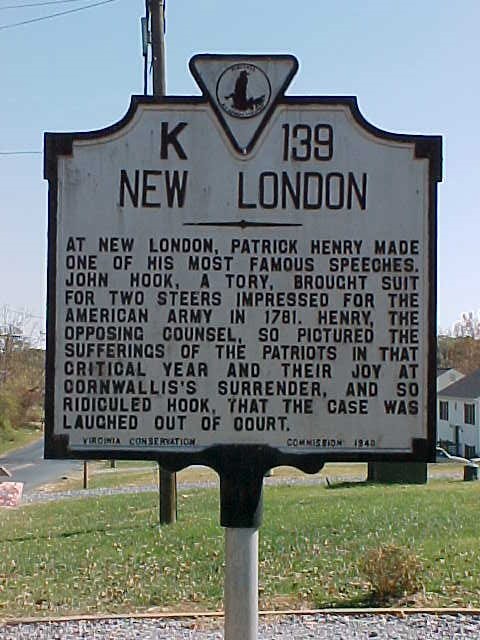
We continue on our way into the town of New London in search of more signs.  Of course, we must stop and read the one for the town itself!
Click to View Full Image

[5]

According to the DHR, New London was on “the old stage road, was the first county seat of Bedford; the first courthouse, built in 1755, was standing until 1856. In 1781, New London was raided by the British cavalryman, Tarleton, seeking military stores. It came into Campbell County in 1782. An arsenal here was afterward removed to Harper’s Ferry.”[6]  According to Howe, “it contains 2 churches, a classical academy, and a few dwellings.  It was founded several years prior to the American revolution.”[7]

Since Mr. Howe has discussed a “classical academy”, let’s head off to see the next road sign – New London Academy.

Click to View Full Image

[8]

This school is still in operation today.  The school’s website offers a history of their establishment.  “Thomas Jefferson’s vision for the education of the masses of the people inspired concerned citizens of this area to request from the General Assembly of Virginia a charter “to incorporate trustees to an academy in the vicinity of New London.”  On December 1, 1795, the Virginia General Assembly approved this bill and appointed prominent Bedford County men as trustees.  Thus, New London Academy, named for the historic little village had its beginning.”[9]   It seems that Thomas Jefferson had a huge impact on New London!  So much so, that he actually had a home in Bedford County named Poplar Forest.
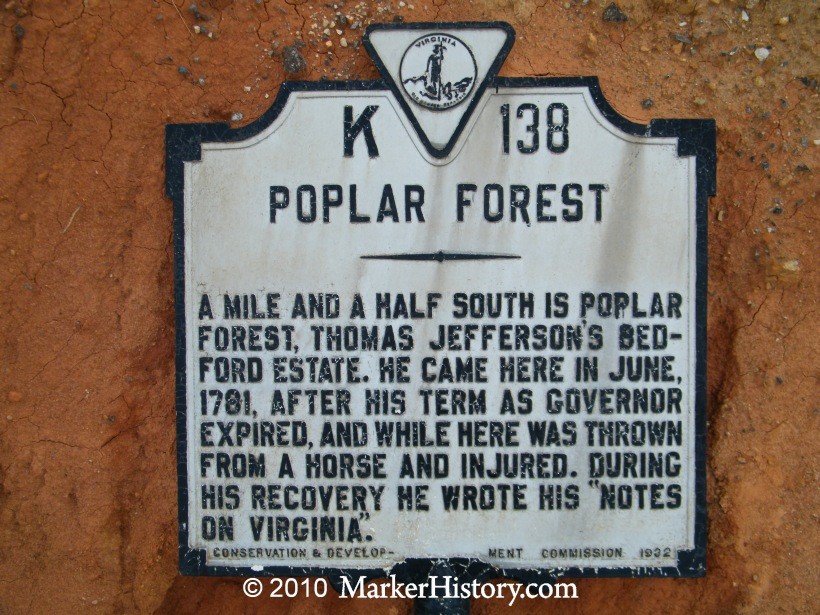
Image result for virginia historical markers k 138

[10]

Thomas Jefferson was friends to many influential members of New London.  Including James Steptoe.  The Callaway-Steptoe Cemetery is final stop on our tour.

Click to View Full Image

[11]

There is more to the town of New London than these few signs but historical signs like these are a way to capture the imagination and look deeper into our shared history.  There is Mead’s Tavern and the Bedford Alum Springs Hotel which are both owned by Liberty University.  “Liberty has plans of archaeological and architectural investigations for the hotel and property.”[12]  There are already archaeological projects at Mead’s Tavern.   You could explore the famous names who called this place home, like William Calloway, Patrick Henry, and Thomas Jefferson.  And the history extends beyond the Revolutionary War!  You can explore Hunter’s Raid which happened during the Civil War.  There is really so much to see, do, and learn!

Historical markers do have a downfall.  They cannot give the full story.  For instance, the sign for New London K 139 states that there was a case involving Patrick Henry and John Hook over two steers but little else is said.  The idea of these signs is to give just a nugget of history to help you want to find the rest of the story! 

I hope you enjoyed our little “trip” and I hope that it inspires you to seek out those historical signs along the side of the road.  Who knows?!  You may jump into a great road trip through history!


[1] Levin, Kevin M. “When It Comes to Historical Markers, Every Word Matters.” Smithsonian.com. Smithsonian Institution, July 6, 2017. https://www.smithsonianmag.com/history/when-it-comes-historical-markers-every-word-matters-180963973/.

*This is from my home in Baltimore County MD.

[2] “Bedford K 134.” Department of Historic Resources. Accessed December 6, 2019. https://vcris.dhr.virginia.gov/HistoricMarkers/.

[3] Howe, Henry. “Historical Collections of Virginia; Howe, Henry, 1816-1893 : Free Download, Borrow, and Streaming.” Internet Archive. Charleston, S.C., W. R. Babcock, January 1, 1970. https://archive.org/details/historicalcollec03howe/page/188.

[4] “Lynchburg and Salem Turnpike K 131.” Department of Historic Resources. Accessed December 6, 2019. https://vcris.dhr.virginia.gov/HistoricMarkers/.

[5] “New London K 139.” Department of Historic Resources. Accessed December 6, 2019. https://vcris.dhr.virginia.gov/HistoricMarkers/.

[6] Ibid.

[7] Howe, Henry. “Historical Collections of Virginia; : Howe, Henry, 1816-1893 : Free Download, Borrow, and Streaming.” Internet Archive. Charleston, S.C., W. R. Babcock, January 1, 1970. https://archive.org/details/historicalcollec03howe/page/218.

[8] “New London Academy K 141.” Department of Historic Resources. Accessed December 6, 2019. https://vcris.dhr.virginia.gov/HistoricMarkers/.

[9] “History of NLA.” New London Academy. Accessed December 6, 2019. https://bedfordnla.sharpschool.net/about_us/history_of_nla.

[10] “Poplar Forest K-138.” Marker History, November 30, -1. http://www.markerhistory.com/poplar-forest-marker-k-138/.

[11] “Callaway-Steptoe Cemetery K 135.” Department of Historic Resources. Accessed December 6, 2019. https://vcris.dhr.virginia.gov/HistoricMarkers/.

[12] “Bedford Alum Springs Hotel.” New London Museum. Accessed December 6, 2019. https://newlondonmuseum.org/bedford-alum-springs-hotel/.

Shaking the Tree

[1]

Every family has stories told by the elders to the younger generations.  Some are stories of amazing bravery and some are just plain tall tales.   Once upon a time in my family, I was told that my grandfather, Pop Pop, had traced our ancestry back to Scotland and Ireland.  He even had our family tartan.  I was about 10 years old and the idea of knowing where my family hailed from was of great interest to me.  Mom Mom told me she gave everything to her only son, my biological father, who threw everything out.  He thought it was junk.  I cried.  But the one good thing that came from it, I developed a passion for history and a love of Scotland. 

Fast forward to the present day and now I am purposely given the opportunity to dig into my family past.  Unfortunately, I’ve lost contact with the Walker side of the family.  (Walker is my maiden name.)  Now I get to do the digging and depend on census records, and other documents to chase down my family tree.  Once I got started, I realized that some of the stories that I had been told weren’t exactly 100% fact.  In the short time I’ve had to chase down my family history, I’ve been able to shake the facts from the fictions.

Story #1 – My grandmother and her siblings were placed in the German orphan’s home in Baltimore.    FACT!

I knew that my Mom Mom was born in Maryland in 1918 so the first place I went was to the 1920’s census.  During that census, my great grandfather, great grandmother, great aunt Ada, great uncle George, and my Mom Mom all lived on Amos Street in Baltimore[2] My great aunt Lil wasn’t born yet.  So, I jumped to the 1930s census.  In that census, Florence, George, Lillian and Virginia were all wards of the General German Orphan Home.[3]  I am not sure why, but I do know that according to the Baltimore Sun obituary, their father Edward/Edwin Levering died in 1923.[4]   Perhaps his death caused his wife Stella to give up their children.   I asked Mom Mom once why she was raised in a home.  She told me that it was during the Great Depression and her mother couldn’t raise four children.  If she gave them to the home, she knew that they would be fed and clothed.  I cannot imagine how difficult that would have been to give up your children, but Mom Mom was still bitter about it after all of those years.

Story #2 – Pop Pop was one of 14 children and none of them was a single birth.  FICTION! 

When I started this project, I had such a difficult time due to the last name.  Walker is like Smith or Jones.  Add William onto Walker and I am searching for a needle in a haystack!  But I have been able to find him and trace him back to my great great grandparents.  My Pop Pop was one of five children and none were multiple births.  Mary Lauren was the oldest but died after only a year old.  Then Pop Pop (William) then Philip, Theodore, and Rita.  I am starting to delve into my great grandfather but again, he was another William Walker.  Le Sigh!

Story #3 – Irene Duffy immigrated from Ireland and met her husband Mr. Walker from Scotland here in the United States.  FICTION – sort of. 

While Irene Duffy was born in the United States, her parents weren’t.  James Duffy was from Scotland and Catherine Duffy (still working on her maiden name) was from Ireland.  The 1900 Census records show that James was from Scotland, Catherine from Ireland and my great great aunt Alice was also born in Scotland.  The three of them arrived in the United States in 1882 and moved to Pennsylvania.  That is where Gennevie, Mary, Regina, Clara, Isabelle, and Irene were born.[5]

There is so much more that I want to know and find out about my family.  This was just the briefest glimpse into the Walker side.  There is my Mom’s side which is the Poe family.  And yes, according to the family story we are related to Edgar Allan Poe, but I want to find out for sure!  Then there is my Dad’s side of the family and their claim is that they are part Cherokee and related to William and Mary of Orange!  Mom has started that branch of the family tree and I know that my cousin on my Dad’s side has the Gribble one started as well. I can’t wait to bring them all together in one giant tree!

Families have many stories and spending time to see what is true is a worthy pastime.  It is fun to shake the tree and see what interesting facts fall into your hands! For me, I now have a tree started on Ancestry.com. I will be spending free time (which is a hard thing to find when you are working on your PhD) searching for more information on my family. Who know? Maybe one day I will find out if the tartan my Pop Pop had was as a member of another clan or one of our own! A walker was a trade name and it meant fuller of the cloth. They were ones who helped in making tartans for the clans. Every clan had walkers but there was a Clan Walker. For my brother, nephew, and myself, I’d like to find out if we are a member of a larger clan or if we have our own family tartan. It is something I’d love to surprise them with – their own kilts. My brother is another William but he likes Scotland as well. So does my nephew. I helped make him a closet Anglophile like me! Hopefully one day I will be able to find the answers.


[1] “Genealogy-Tree-Tag-Cloud-White-Background-Edited.” Adrian Area Chamber of Commerce. Accessed November 28, 2019. https://www.adrianareachamber.com/event/ldl-genealogy-group/genealogy-tree-tag-cloud-white-background-edited/.

[2] “US Census Bureau Publications – Census of Population and Housing.” Census of Population and Housing – Publications – U.S. Census Bureau- 1920, August 19, 2011. https://www.census.gov/prod/www/decennial.html.

[3] “US Census Bureau Publications – Census of Population and Housing.” Census of Population and Housing – Publications – U.S. Census Bureau- 1930, August 19, 2011. https://www.census.gov/prod/www/decennial.html.

[4] “The Baltimore Sun from Baltimore, Maryland on June 27, 1923 · 17.” Newspapers.com. The Baltimore Sun. Accessed November 29, 2019. https://www.newspapers.com/newspage/373403412/.

[5] “US Census Bureau Publications – Census of Population and Housing.” Census of Population and Housing – Publications – U.S. Census Bureau- 1900, August 19, 2011.

Sowing the Seeds

            Colonial Americans had many challenges facing them on a daily basis.  Some were carving their very homes out of the preverbal wilderness.  Others were seeking their success in the towns and cities.  During the 1760s, tensions were on the rise with England and many felt that it was time for a new nation.  But what kind of nation would it be?   

            In December of 1767, John Angier wrote a sermon for the ordination of Samuel Angier.  The sermon was entitled “A Sower going forth to Sow the Seed of God’s Word.”[1]  Angier based the sermon on Matthew 3 and the Parable of the Sower of the Seed.  Angier admonishes that God’s word is the purest of seeds that must be tended to so that it may flourish.  He writes that like “our Blessed Savior…. he has respect also, to the dispensation of it, by such as are authorized and sent out by him for that purpose.”[2]  Ministers are to be like Jesus and be the sower of the Word of God. 

            Like when Jesus spoke the Parable of the Sower, Angier uses in his sermon to help the newly ordained minster to understand that not everyone will understand what he is saying but he must continue to spread God’s Word. 

“So, God’s promise came true, just as the prophet Isaiah had said,

“These people will listen and listen, but never understand.
 They will look and look, but never see.
All of them have stubborn minds!
Their ears are stopped up, and their eyes are covered.
They cannot see or hear or understand.
If they could, they would turn to me,     and I would heal them.”

But God has blessed you, because your eyes can see, and your ears can hear! Many prophets and good people were eager to see what you see and to hear what you hear. But I tell you that they did not see or hear.”[3]

            While ministers like John and Samuel Angier had their “eyes opened” to the Word of God.  It was their duty to help spread the word.  Sometimes it would fall on people who were like the road and it wouldn’t remain with them.  Sometimes it would fall on people who were shallow and once trials happened, they would lose faith.  But some would fall on those who were like the good soil and it would take root in their hearts and minds and soul.  They would know how to turn away from sin and corruption because they were blessed with the Word.  He writes that “ministers should make suitable remarks upon, and lead their people into adoring apprehensions of, the wisdom, and power, and the goodness of God, displayed therein: teaching them the wise, and the good use… that they may reap real benefit… in the service of God.”[4]       

            Angier was calling for Samuel, and all ministers, to be the ones who bring the light of God into all men’s hearts.   There were many different denominations of Christianity in the Colonies.  Puritan, Quaker, Catholic, Protestant, Anglican, and others. Then you add to that the native population whose own views on Christianity are limited.  A good and faithful minister should go out and spread the word wide and far so as to gather as much of the flock to God.  It is the old adage that we reap what is sown. 

For ministers, pastors, and priests, the Colonies provided a new outlet for their holy work.  This was a chance to move away from the persecution that was found in England and spread the Word among others.  This idea of spreading the word is why Christianity was so important in the Colonies.  It was a new land and new opportunities to do the work that God had given them.  It was their chance to help bring people to the light and love of God.

He completes his sermon by saying “but then you must be doers of the Word, and not hearers only: for if any man be a hearer of the word, and not a doer, he is like unto a man beholding his natural face in a glass: for he beholdeth himself and goeth his way.  But whose looketh into the perfect law of liberty, and continueth therein, he being not a forgetful hearer, but a doer of the work, this man shall be blessed in his deed.”[5]  He wanted that “good seed of God’s Word take deep root in our hearts.”[6]

            Whether deep in the troubled times of the Revolution or in today’s troubled times, his words ring true no matter the denomination of Christianity.  Each person has the opportunity to be a doer of the Word and help to sow the seeds of the Word to all who would listen.  Just as the prophet Jeremiah said “Then the word of the LORD came unto me, saying before I formed thee in the belly I knew thee; and before thou camest forth out of the womb I sanctified thee, and I ordained thee a prophet unto the nations.”[7]  We are called to be a sower of the good seed.


[1] Angier, John. 1768. A Sower Going Forth to Sow the Seed of Gods Word.: A Sermon Preached December 23d, 1767. At the Ordination of the Reverend Mr. Samuel Angier, to the Pastoral Care of the Third Church in Bridgwater. Colleague with His Father. Boston: Printed by William Malpine, about mid-way between the governors, and Dr. Gardiners, Marlborough-Street.

[2] Ibid, pg. 7.

[3] “BibleGateway.” 2019. Matthew 13 CEV – – Bible Gateway. 2019. https://www.biblegateway.com/passage/?search=Matthew+13&version=CEV.

[4] Angier, pg. 20.

[5] Ibid, pg. 22.

[6] Ibid, pg. 23.

[7] “BibleGateway.” n.d. Jeremiah 1 KJV – – Bible Gateway. Accessed November 22, 2019. https://www.biblegateway.com/passage/?search=Jeremiah+1&version=KJV.

My PhD Journey

Hello! I wanted to give you a little update on the progress of this project up to this point. I am attending Liberty University for my PhD in History and am doing this completely online. Which means that I have a full time job (40+ hours a week), volunteer with my local fire department, AND have a family plus a farm. There is this thing called SLEEP. I don’t know if you’ve heard of it or not, but it is the most wonderful thing! I am lucky if I am able to pull out three – four hours of sleep a night but I signed up for this! One day, I’ll find SLEEP and be able to enjoy it! Ha ha!

There are officially three more blogs to create for this class. The are on Christianity in America, Genealogy, and Collaborative Research. While I only have a couple of blog posts to create for this class, I do have videos to create each week. The videos I’ve created so far have dealt with how Hollywood has portrayed history. Below are the links and description of each video for my class.

The video I created last night/early this morning is all about the Sons of Liberty and primary sources. It is a project created for a history professor teaching American History I, but I liked the idea too much not to share it!

Here are the links to my current videos.

History and Hollywood – https://www.youtube.com/watch?v=2BGmhBZ7BV4&t=27s

History and Hollywood Part 2 – https://www.youtube.com/watch?v=XAIajXryAdY&t=43s

Sons of Liberty – Patriots or Terrorists – https://www.youtube.com/watch?v=KGqaW4GuP-o&feature=youtu.be

Let me know what you think! Have a great weekend!

Kathy

Chasing Carmen Sandiego

[1]

When I was growing up, video and computer games were in their infancy.    We didn’t have the amazing graphics in all their technicolored glory.  The first video game I played was Atari Pong.  The first computer game was Oregon Trail which I could never beat!  I always died of dysentery long before I ever made it to Oregon.

In my teens, games started to evolve and one of my favorites was the Carmen Sandiego series.  I loved chasing her across the United States and around the world, looking for clues to catch the bad guys!  In 1999, the greatest one of the series, in my humble opinion, came out – Carmen Sandiego’s Great Chase Through Time.  This game allowed me to chase her through history!

I bet you’re wondering why this game is so important to me.   The Carmen Sandiego series was more than just a game.  It allowed the player to learn while having fun.  Don’t believe me?  You can play three new Carmen Sandiego’s adventures on Google Earth.  You can find the Crown Jewels, the Keys to the Kremlin, or Tutankhamun’s Mask (links below).[2]  In the series, each player was able to learn about art, geography, science, and most importantly, history. 

 For most kids, history is boring.  It is a rare teacher that can make history exciting for his/her students.  It’s all names, dates, and places.  Blah blah blah.  So, introducing a game like Carmen Sandiego adds an element of fun!  It, like historical movies, can be the springboard a student needs to find a love of history.  It may not be historically accurate in all accounts, but if presented correctly, it can be the little spark that makes the flames ignite. 

 Think back to your days in high school.  Was your class exciting?  Do you remember having fun and learning something new and different?  Did it challenge you to think creatively and dig deeper for a fuller understanding as to the reasons why this event happened or what repercussions occurred?  Most people will answer no.  And this, my dear reader, is why people hate history.  Names. Dates. Places.  Cue the sound of the Peanuts teacher talking.

What if it could be different?  Professor Marcus Collins had a brilliant idea.  He gave an assignment to his freshman college students and asked them to “write ‘a historiographical analysis of the history you studied at school.”[3]  The article titled “Historiography from below: How undergraduates remember learning history in school”, examines how these students remembered their classes then and now.  Many of these young historians stated that their elementary school time was spent with traditional form of history.  The teachers taught the traditional/Rankean method “because it is simpler to teach the basics in order to understand more broad history later on.’”[4]  Some of the students stated that when they reached high school, the teachers started to expand their knowledge beyond the traditional views, seeking to show them a more global experience to history.  They were “exposed to “new” history in action, represented by ‘more complex topics, such as social standings and … economic influences.”[5] This allowed them the opportunity to gain a deeper understanding of history. But sadly, some of the students stated that they knew no other way of learning history except the traditional way, so it was a shock when they entered college and began to see new ways of exploring it.

To be honest, this is exactly how I learned history.  Names, dates, places.  When I was at university, I was taught to teach history the same way to my students.  Historiography wasn’t something that was discussed.  So, imagine my shock when I returned to get my master’s and had a WHOLE NEW WAY of learning about history!  It had been 15 years since I attended college and now everything was different! 

The study of history is something that must evolve and grow especially where our students are concerned.  Professor Caroline Hoefferle explains why we need to teach the study of history, and especially historiography, to our students.  She writes in her article, “Teaching Historiography to High School and Undergraduate Students”, “that most high schools and undergraduate courses heavily rely on textbook readings.  History textbooks are normally written in a narrative format, which sends the message to students that they are simply presenting “the truth” about the past, implying that there are no other interpretations of the events, no other truths about the past.”[6]  She goes on to say that teaching “historiography not only enlightens students as to the inside story of the historical profession, but it also makes history more alive and interesting to them.  This takes them away from being simply passive receivers of the truth, to active pursuers of the truth.”[7]  What an amazing concept!  Making history interesting!

  Professor Eric Morgan continued this idea when he used the virtual world of Second Life “to transport [his students] to Europe during the summer of 1916, to the very epicenter of the First World War.”[8]  Imagine being taught World War I like that!  A new way of experiencing history can make all the difference.

I had teachers who made their subjects fun so much so that when I taught, I wanted to do the same thing.  Funny thing is, I now have former students who are now teachers and are adding fun to their classes too because I showed them learning could be fun.  I guess chasing Carmen wasn’t such a bad idea after all!

Links:

Crown Jewels: https://earth.google.com/web/@1.50184563,-12.41938094,-26243.34460046a,63196239.48846817d,35y,359.99993244h,0t,0r/data=CjwSOhIgYmU3N2ZmYzU0MTc1MTFlOGFlOGZkMzdkYTU5MmE0MmEiFnNwbC14LXgteC1zcGxhc2hzY3JlZW4

Keys to the Kremlin: https://earth.google.com/web/@17.90693717,-12.41937117,-34607.65249819a,57359668.97d,35y,0.00004064h,18.19296234t,0r/data=CjwSOhIgZjJhMmExN2E0MDZlMTFlOTk5MGE5OWYyYWQ2OTYwMTgiFnNwbC14LXgteC1zcGxhc2hzY3JlZW4

Tutankhamun’s Mask: https://earth.google.com/web/@17.90693717,-12.41937117,-34606.55899502a,57359668.97d,35y,0.00004064h,18.19296234t,0r/data=CjwSOhIgN2ZhM2Q1Njg0MDZlMTFlOTg2Y2U5OWYyYWQ2OTYwMTgiFnNwbC14LXgteC1zcGxhc2hzY3JlZW4

Bibliography

“Carmen Sandiego’s Great Chase Through Time (The Learning Company) (1999): The Learning Company: Free Download, Borrow, and Streaming.” Internet Archive. The Learning Company, January 1, 1999. https://archive.org/details/CarmenSandiegosGreatChaseThroughTimeTheLearningCompany2001Disc2Of2.

Collins, Marcus. “Historiography from Below: How Undergraduates Remember Learning History at School.” Teaching History, no. 142 (2011): 34-38. http://www.jstor.org/stable/43260435.

“Follow Carmen Sandiego Across Google Earth!” Carmen Sandiego – Houghton Mifflin Harcourt. Accessed October 30, 2019. https://www.carmensandiego.com/game/.

Hoefferle, Caroline. “Teaching Historiography to High School and Undergraduate Students.” OAH Magazine of History 21, no. 2 (2007): 40-44. http://www.jstor.org/stable/25162115.

Morgan, Eric. J. “Virtual Worlds: Integrating “Second Life” into the History Classroom.” The History

Teacher 46, no. 4 (2013): 547-59. http://www.jstor.org/stable/43264156.


[1] “Carmen Sandiego’s Great Chase Through Time (The Learning Company) (1999): The Learning

Company” Internet Archive. The Learning Company, January 1, 1999.  

[2] “Follow Carmen Sandiego Across Google Earth!” Carmen Sandiego – Houghton Mifflin Harcourt.  Accessed October 30, 2019. https://www.carmensandiego.com/game/.

[3] Collins, Marcus. “Historiography from Below: How Undergraduates Remember Learning History at School.” Teaching History, no. 142 (2011): 34-38. http://www.jstor.org/stable/43260435.

[4] Ibid, pg. 36.

[5] Ibid, pg. 36.

[6] Hoefferle, Caroline. “Teaching Historiography to High School and Undergraduate Students.” OAH Magazine of History 21, no. 2 (2007): 40-44. http://www.jstor.org/stable/25162115.

[7] Ibid, pg. 41.

[8] Morgan, Eric. J. “Virtual Worlds: Integrating “Second Life” into the History Classroom.” The History Teacher 46, no. 4 (2013): 547-59. http://www.jstor.org/stable/43264156.

All about me….

Welcome to Seeking History! My name is Kathy Milby! I am currently working on my PhD in History at Liberty University. This blog site is part of my PhD project and it is my hope that I will be making more of it than simply a homework assignment!

When I am not working on my degree, I work full time, have a husband and family, and own a small farm. I am a volunteer with my local fire department and represent them to both the county and state fire associations!

I am so glad you’re here joining me on this fun trip through history! Let me know if you’d to know anything in particular!

Have a great day! Kathy